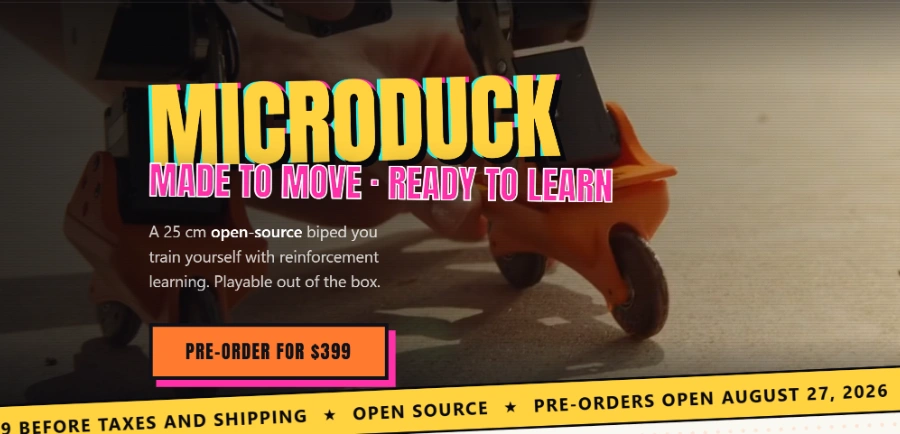
« A small, duck-shaped, bipedal robot, fully open source, that learns to walk, stand up, and grasp objects. It operates using reinforcement learning policies trained in simulation and then transferred to the real device. Ready to use right out of the box
»
Microduck: Pollen Robotics' $399 biped duck falls over, gets back up and learns new tricks
Updated on August 30, 2026
Microduck is a 25 cm bipedal robot from Pollen Robotics, the Bordeaux-based robotics team at Hugging Face, built to learn physical behaviors through reinforcement learning. Fifteen motors, a camera, LiDAR and a grasping beak let it walk, pick up objects and stand back up after a fall. Pre-orders sit at $399 before taxes, game controller included. Developers, teachers and robotics tinkerers are the main audience, though the bundled moves make it playable on day one.
Pros
Playable right away with the bundled controller
Stands back up on its own after falls
Fully open source software stack on GitHub
Trains fresh behaviors in simulation
Light enough to fail safely on a desk
Cons
Several months of wait on new orders
Battery lasts about an hour per charge
Aimed at developers more than young kids
Seven trained moves in the box, one gamepad to drive Microduck
Microduck ships with seven pre-trained behaviors, including walking, kicking a ball, grabbing with its beak, roller-skating and self-recovery. You push the stick on the bundled controller, the duck waddles over to a stray sock and picks it up. It also follows a laser pointer and reacts to NFC-tagged accessories.
Each robot generates its own voice on first boot and keeps it for life (no two ducks quack alike, a strangely endearing touch). Four shells exist, Cream, Graphite, Lavender and Sky, with the same mechanics underneath.
Video overview of the Microduck robot by its manufacturer, Pollen Robotics
From simulation to living-room floor, the training loop behind the duck
The full software stack is open source, from the SDK to the reinforcement learning code published on GitHub. Behaviors are trained in the MuJoCo physics simulator, then moved onto the real robot with a documented sim-to-real recipe. One or two hours on a GPU produce a usable gait, and Hugging Face Jobs handles the job if you lack a graphics card. Releasing an entire training pipeline this way remains rare, even among AI projects on GitHub.
The approach extends Reachy Mini, the desktop robot from the same team, which has shipped more than 10,000 units. Where its sibling talks, Microduck walks, falls and tries again, and its 800 grams keep experiments safe at home or in class. As for the parent company, Pollen Robotics joined Hugging Face, itself bought by Nvidia in a 12.9 billion dollar deal.
Microduck pre-orders, accessory packs and spare parts
The base kit costs $399 before taxes and shipping, covering the robot, a removable battery rated for roughly one hour, a USB-C cable and a controller. Demand ran hot from the start, with pre-orders passing one million dollars within hours of launch. Since figures like these move as production ramps up, check the official store before committing.
Pack
What is inside
Base kit
Robot, battery, USB-C cable, gamepad
Play pack
Laser pointer, two rollers, ball, NFC tags
Battery pack
Two batteries and a dual charger
Spare parts pack
Three spare motors, cables, batteries, charger, screwdriver
$399 before taxes and shipping for the base kit, which includes the robot, a battery and a game controller. Optional accessory and spare parts packs are sold separately, and bulk pricing kicks in from ten units for schools, labs and companies.
Is Microduck open source?
The software is, entirely. The SDK, simulation and reinforcement learning stack are published on GitHub for anyone to read, fork and retrain. The mechanical and electronic design files are not open, and Pollen Robotics asks that the robot not be described as open source hardware.
When will Microduck ship?
Four to six months is the current estimate for new orders, shipped first ordered, first served. The earliest buyers were targeted for delivery before Christmas, but heavy demand stretched the queue and the company says production is ramping up.
Microduck vs Reachy Mini, which one should you get?
Reachy Mini focuses on conversation and expressiveness on a desk, while Microduck is all about movement, from walking to falling to reinforcement learning. Both share the same open philosophy at Pollen Robotics. Pick the first for a talking companion, the second for training physical behaviors.
Verdict: For under $400, tinkerers, teachers and robotics labs get a physical AI testbed engineered to fall and pick itself back up. Anyone after a chatty desk companion will find Reachy Mini waiting at the same maker.
To provide the best experiences, we use technologies such as cookies to store and/or access device information. Consenting to these technologies will allow us to process data such as browsing behavior or unique IDs on this site. Failure to consent or withdrawal of consent may adversely affect certain features and functions.
Functional
Always active
Storage or technical access is strictly necessary for the legitimate purpose of enabling the use of a specific service explicitly requested by the subscriber or Internet user, or for the sole purpose of transmitting a communication over an electronic communications network.
Preferences
Storage or technical access is necessary for the legitimate purpose of storing preferences that are not requested by the subscriber or person using the service.
Statistics
Storage or technical access used exclusively for statistical purposes.Storage or technical access which is used exclusively for anonymous statistical purposes. In the absence of a subpoena, voluntary compliance by your Internet service provider or additional third-party records, information stored or retrieved for this sole purpose generally cannot be used to identify you.
Marketing
Storage or technical access is necessary to create profiles of Internet users in order to send advertisements, or to track the Internet user on a website or on several websites with similar marketing purposes.
To provide the best experiences, we use technologies such as cookies to store and/or access device information. Consenting to these technologies will allow us to process data such as browsing behavior or unique IDs on this site. Failure to consent or withdrawal of consent may adversely affect certain features and functions.
Functional
Always active
Storage or technical access is strictly necessary for the legitimate purpose of enabling the use of a specific service explicitly requested by the subscriber or Internet user, or for the sole purpose of transmitting a communication over an electronic communications network.
Preferences
Storage or technical access is necessary for the legitimate purpose of storing preferences that are not requested by the subscriber or person using the service.
Statistics
Storage or technical access used exclusively for statistical purposes.Storage or technical access which is used exclusively for anonymous statistical purposes. In the absence of a subpoena, voluntary compliance by your Internet service provider or additional third-party records, information stored or retrieved for this sole purpose generally cannot be used to identify you.
Marketing
Storage or technical access is necessary to create profiles of Internet users in order to send advertisements, or to track the Internet user on a website or on several websites with similar marketing purposes.