Consensus
#7 in Research & Science
« Get deep insight into scientific research from an AI-powered search engine »
Similar AI Tools
 SciSpace AI Writer
  Perplexity AI
  Liner AI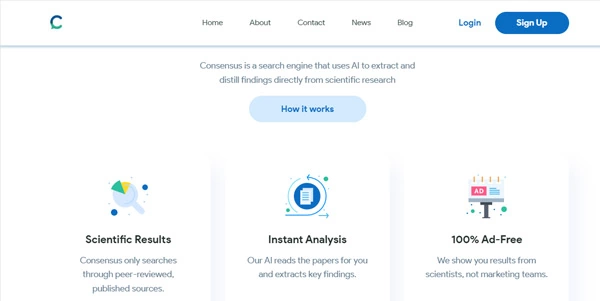


Updated on August 8, 2026
Consensus is an AI search engine for academic research: it scans over 200 million peer-reviewed papers and writes a cited synthesis where every claim links back to a real study. Its signature Consensus Meter shows what share of studies answer yes, no or maybe to your question. Basic search costs nothing, while Premium starts at $8.99 per month billed annually. Clinicians, PhD candidates and science writers lean on it to check claims fast.
Consensus answers from papers published in refereed journals, never from the open web. You type "does creatine improve memory?", the engine pulls the relevant studies, writes a cited summary and, for yes-or-no questions, displays the split between supporting, opposing and mixed findings.
Every result comes with a Study Snapshot, a quick card covering method, sample and conclusion. And when a paper deserves better than a skim, Ask Paper lets you question its text directly. The whole system leans on peer review, a safeguard general-purpose chatbots simply lack.
Deep Search is the most ambitious feature on the platform: it expands your search terms, walks citation graphs and returns a report with a results timeline, leading authors and remaining gaps in the literature. A separate Medical Mode narrows results to high-grade clinical sources, guidelines included.
One handy bridge: an official MCP server plugs these searches into ChatGPT or Claude, so your AI conversations cite published work instead of fuzzy recollections.
| Feature | What you get |
|---|---|
| Consensus Meter | The yes, no, mixed split across studies on a closed question |
| Study Snapshot | Method, sample and conclusion of a paper in a few lines |
| Ask Paper | Answers drawn from the text of one specific paper |
| Deep Search | A synthesis report with timeline and key authors |
| Medical Mode | Results limited to top-tier medical sources |
The free plan requires no credit card and includes limited monthly credits for the analysis features. Premium lifts those caps from $8.99 per month on annual billing, with a student discount available; an application-only API is billed from $0.10 per call. Figures like these shift often, so treat the consensus.app pricing page as the final word.
Students building their toolkit will want to weigh it against other AI picks for students before settling on a stack. (A detail worth smiling at: founders Eric Olson and Christian Salem met on the Northwestern football field before starting the company in 2021.)
Yes, a free plan exists with no credit card, including limited monthly credits for analysis features such as Study Snapshots. Premium removes those caps from $8.99 per month billed annually. Students get a discount, and some universities provide campus-wide access, so ask your library before paying out of pocket.
No fabricated references: Consensus only writes from papers actually retrieved in its database, and every link points to a real publication. University library guides note that imprecise summaries remain possible, though rare, and that full citations are never invented. Double-check sensitive passages before quoting them in your own work.
Consensus shines when you want a fast, sourced answer and a measure of agreement across studies, while Elicit builds structured extraction tables aimed at systematic reviews. Many researchers run both: Consensus to scope a question and spot key papers, Elicit to organize the detailed analysis of the papers they keep.
Less well than for experimental sciences: the database favors journal articles and conference proceedings, without books or book chapters, which hurts fields where the monograph rules. History and philosophy queries come back thin. Medicine, psychology and ecology, on the other hand, enjoy excellent coverage.
Verdict: Ten minutes to learn what the literature actually says, percentage of agreement included: that is the deal on the table. Clinicians, grad students and evidence-minded writers will get the most from it, and humanities scholars can keep it as a first stop before their specialist databases.

« An all-in-one creative platform that brings together more than 30 image and video models in a single interface. It includes camera controls that let you direct like a real filmmaker, characters that remain consistent from scene to scene, and ready-to-use tools for ads and short-form content »