Liner AI
#3 in Search engine
« An AI copilot for your workspace, powered by ChatGPT. Quickly find information and reference sources to improve your research efficiency »
Similar AI Tools
 Perplexity AI
  SearchGPT
  ChatGPT Atlas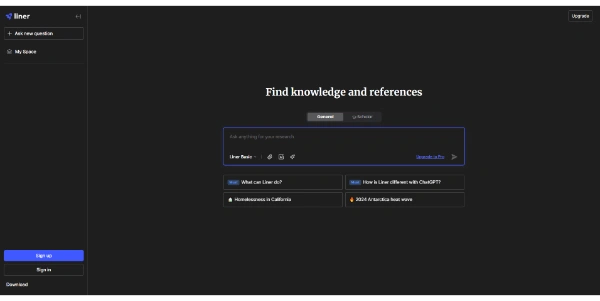


Updated on August 17, 2026
Liner AI is an AI search engine that backs each of its answers with verifiable sources pulled from the web and academic papers. Born in Seoul in 2012 as a humble web highlighter, it now counts over 13 million people on board and a 95.3% score on OpenAI's SimpleQA benchmark. A free plan lets you kick the tires, with paid tiers opening up the heavier research agents. The interface is English-only for now, though the AI happily answers in other languages.
Liner AI attaches references to every answer it gives, from mainstream websites to peer-reviewed journals. The Korean company, founded in 2012, first built its reputation on a web page highlighter before rebuilding everything around AI search. Recent models from OpenAI, Google and Anthropic handle the reasoning, while Liner assembles a summary where each claim links back to its source.
Paste the link of an hour-long YouTube video and the key points land within seconds, timestamps included. The browser extension for Chrome, Safari or Edge brings highlighting and summaries straight onto the pages and PDFs you read.
Three workspaces split the job, Liner for everyday questions, Liner Scholar for scientific papers and Liner Write for drafting. Fast Company even ranked the company second on its list of the most inventive education businesses, ahead of Coursera and Duolingo.
Against Perplexity, Liner plays the academic card, a lane now packed with study-focused AI picks. Its secret weapon remains traceability, since every sentence can be double-checked in a single hover.
| Profile | What Liner AI brings |
|---|---|
| Student | Scholar mode plus APA, MLA or Chicago citations in one step |
| PhD researcher | Deep Research for literature reviews and blind spots |
| Analyst or consultant | Digests bulky PDFs, reports and slide decks |
| Investor | Reads how market news may hit the stocks you follow |
| Journalist | Fact-checking with clickable sources |
A free account is enough to try sourced search, though agent runs are capped at one or two per month. The Pro plan sits around $18 per month, closer to $15 on annual billing, while Max climbs toward $36 with expanded Deep Research, image generation and file uploads up to 200 MB.
Teams get a tier at $26.99 per member, with company data kept out of model training (a detail legal departments tend to appreciate, and they are not alone). A credit system meters agent activity, so keep an eye on the counter. Since these figures shift with each product update, the grid published on liner.com is the one that counts.
Yes, a free plan covers basic sourced search, highlighting and a few summaries. Agent runs are capped at one or two per month there, and the strongest models stay behind the paywall. For heavy research routines, moving up to Pro quickly becomes the natural next step.
Both cite their sources, but Liner digs into the academic lane with its Scholar mode, formatted citations and built-in highlighter, while Perplexity sweeps a broader general web. For a thesis, a dissertation or a literature review, Liner's university-first slant carries real weight.
You can ask questions in French, Spanish or other languages and get answers back in the same tongue, since the underlying models are multilingual. The interface, documentation and support channels remain English-only for now, which is worth knowing before rolling it out to a team.
Each agent action burns credits in proportion to task complexity, roughly 50 for a routine summary and up to 200 for research hypothesis generation. Worth knowing, support sometimes refunds credits when an agent botches a job, which softens the sting on pricey runs.
Verdict: A literature review sketched out during a coffee break, receipts included, that is what Liner AI hands to students, PhD candidates and analysts who refuse to quote an AI without proof.

« An all-in-one creative platform that brings together more than 30 image and video models in a single interface. It includes camera controls that let you direct like a real filmmaker, characters that remain consistent from scene to scene, and ready-to-use tools for ads and short-form content »