Scispace
#63 in Research & Science
« An AI to help you understand and easily read scientific literature (research papers, etc.) »
Similar AI Tools
 SciSpace AI Writer
 Perplexity AI
 Liner AI


Updated on November 8, 2026
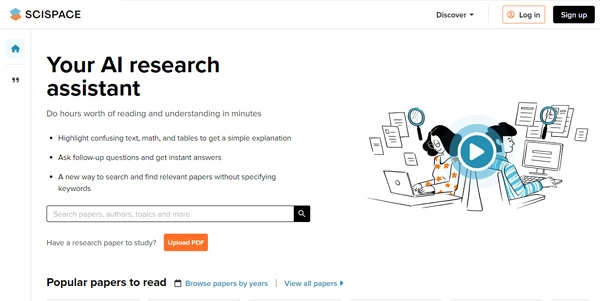
SciSpace is an AI-powered research assistant built by PubGenius Inc. (formerly Typeset), covering the full academic workflow from paper discovery across 280 million+ articles to literature review, PDF comprehension, citation generation and draft writing. The company was founded in 2016 in Bengaluru by Saikiran Chandha and Shanu Kumar, and claims over 10 million researchers at institutions such as Harvard, Yale and Stanford. A Free plan provides basic access; paid tiers start at $12/month (Premium, billed annually) and go up to $70/month for Advanced.
SciSpace aggregates papers from Google Scholar, PubMed, arXiv, OpenAlex and Semantic Scholar into a single searchable index. You type a research question in plain language and the agent returns cited answers linked to individual papers. The Biomedical Agent focuses on medical literature, while the Agent Gallery lists over 500 themed agents according to the publisher.
Chat with PDF lets you interrogate a loaded paper directly: the system highlights relevant passages, breaks down equations and clarifies acronyms in up to 13 languages through the Chrome extension. On the writing side, the AI Writer generates outlines, inserts references and exports to multiple formats. A paraphraser, AI detector, plagiarism checker and APA/MLA/Chicago citation generator round out the toolkit.
Everything runs on the web, through a Chrome extension (300,000 users, 4.3/5 rating) and an iOS app released in March 2025. For R&D teams and developers, a REST API ships with a free Developer tier (500 credits/month) and a Scale tier at $99/month.
The Free plan includes limited Copilot access, a basic literature review workflow and citation extraction. All paid plans carry a 24-hour money-back guarantee and can be cancelled any time.
| Plan | Monthly | Annual (per month) | Highlights |
|---|---|---|---|
| Free | $0 | $0 | Limited Copilot, basic lit review, citations |
| Premium | $20 | $12 | Higher quotas (details not published) |
| Advanced | $70 | $70 | Highest quotas (details not published) |
| Team | $18/seat | $8/seat | Per-seat billing for teams |
API pricing sits on a separate track: Developer is free (500 credits/month), Scale costs $99/month, and Enterprise is quoted individually with EU data residency and a DPA. Prices may change; check the official site for the latest figures.
Consensus stands out with its consensus meter (a visual yes/no/mixed gauge for clinical questions) and journal-quartile filters. Elicit remains the go-to for large-scale systematic screening with configurable extraction columns. SciSpace differentiates itself through breadth: it spans discovery, reading, extraction, specialized agents and draft writing within one account.
An internal benchmark run by the SciSpace team across 200 queries reported that Deep Review surfaced an average of 26.3 highly relevant papers per query, versus 16.1 for Consensus Pro and 15.7 for Consensus Deep. Those numbers come from the publisher itself, so they indicate a ballpark rather than an independent verdict. In practice, many researchers chain several of these tools depending on the stage of their project: Consensus for a quick evidence check, Elicit for structured screening, SciSpace for deep reading and drafting.
Yes. A Free plan gives limited Copilot access, a basic literature review workflow and citation extraction at no cost. Premium costs $20/month ($12 billed annually), Advanced is $70/month, and Team plans drop to $8/seat/month on yearly billing. Every paid plan includes a 24-hour money-back guarantee.
Open the Literature Review tool, type your research question and SciSpace searches its 280M+ paper index. It returns a structured table of relevant papers with inline citations. You can then extract data into custom columns and export results as CSV or BibTeX. Deep Review extends this with a systematic-review workflow.
PubGenius Inc., headquartered in Milpitas, California, operates SciSpace. The company was founded in 2016 by Saikiran Chandha and Shanu Kumar, originally under the name Typeset. It is backed by investors including Inventus Capital and Silicon Valley Quad, for an undisclosed amount.
SciSpace displays a SOC 2 compliance badge at trust.scispace.com, and the Enterprise API plan adds a Data Processing Agreement with EU data residency. The publisher does not state clearly on its product pages whether uploaded PDFs are used to train its models. Reviewing the official Privacy page is recommended before uploading sensitive material.
Verdict: From a 280-million-paper search engine to draft writing with inline citations, SciSpace covers more stages of the research lifecycle than most rivals. PhD students, lab teams and R&D departments looking to compress weeks of bibliography work into focused sessions will find it worth a trial run on the free plan.

« An all-in-one creative platform that brings together more than 30 image and video models in a single interface. It includes camera controls that let you direct like a real filmmaker, characters that remain consistent from scene to scene, and ready-to-use tools for ads and short-form content »