Genmo AI
#10 in Text-to-video
« Generates images from text and transforms them into video »
Similar AI Tools
 Text to Video AI: Deevid
  Kling 3.0
  MiniMax H3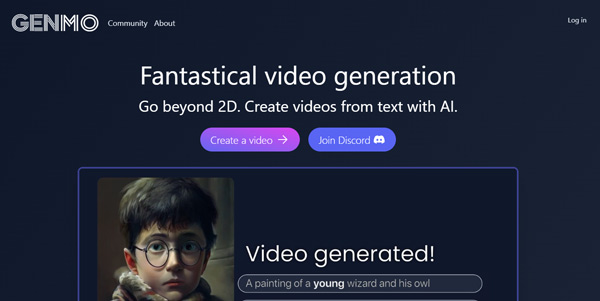


Updated on September 14, 2026
Genmo AI is the American research lab behind Mochi 1, an open-source text-to-video model released under the Apache 2.0 license. You can generate clips in its hosted playground, free to try, or grab the weights and run everything on your own hardware. Paid plans begin at $10 a month with the Lite tier. The company raised $28.4 million in Series A funding led by NEA around the model's release.
Mochi 1 is a diffusion model with 10 billion parameters, published by Genmo in October 2024 as the largest openly released video model at the time. It generates 5.4-second clips at 480p and 30 frames per second, with two recognized strengths, motion quality and prompt adherence.
In practice, you type a sentence, say a slow-motion shot of a glass shattering on the floor, and the clip lands in your gallery a few minutes later. Tinkerers fetch the code and weights from GitHub or Hugging Face instead, a familiar route for open-source AI projects.
| Spec | Detail |
|---|---|
| Resolution | 480p |
| Clip length | 5.4 seconds, 163 frames at 30 fps |
| License | Apache 2.0, modification permitted |
| Best-suited style | Photorealism |
| Platform cost | 100 credits per Mochi video |
Genmo counts among the pioneers of text-to-video, with a first video model launched back in 2022. The lab, led by Paras Jain, is advised by figures such as Ion Stoica, co-founder of Databricks, and Pieter Abbeel, an early OpenAI team member.
Since then, open models like Wan and HunyuanVideo have pushed resolution higher. Mochi 1 still holds its ground with researchers and developers, thanks to a deliberately simple architecture, permitted fine-tuning and an active ComfyUI community. If you write prompts often, detailed English descriptions of motion and camera work get the best results.
Trying Genmo costs nothing. The base tier includes 250 lifetime credits, unlocked by adding a payment method that is never charged (worth knowing before you reach for your card), with a watermark on exports.
One Mochi video burns 100 credits, so Lite covers twelve clips a month. These figures shift over time, so check Genmo's pricing page before committing.
Yes, the playground is free to try and the base tier includes 250 lifetime credits, with watermarked output for personal use. The Mochi 1 model itself downloads at no cost under the Apache 2.0 license, provided you have the hardware to run it. Subscriptions mainly remove the watermark and raise your monthly volume.
That depends on how you generate. Locally, the Apache 2.0 license permits commercial use and modification of the model. On the hosted platform, commercial rights start with the Lite plan, while the free tier stays limited to personal use with a watermark.
Around 20 GB of VRAM is enough through ComfyUI, which optimizes memory. The official repository recommends at least one H100 GPU, which is data-center hardware. Without a large graphics card, the hosted playground or a rented cloud GPU remains the simplest path.
Runway is a closed, production-oriented platform with proprietary models and built-in editing tools. Genmo plays a different game, an open model you can inspect, fine-tune and self-host. For full technical control on a tight budget, Genmo's open-source approach carries real weight.
Verdict: Tinkering with a video model on your own machine, license fees excluded, is what Genmo made possible. Developers, researchers and text-to-video hobbyists get an open sandbox here, with the hosted playground to validate an idea before installing anything.