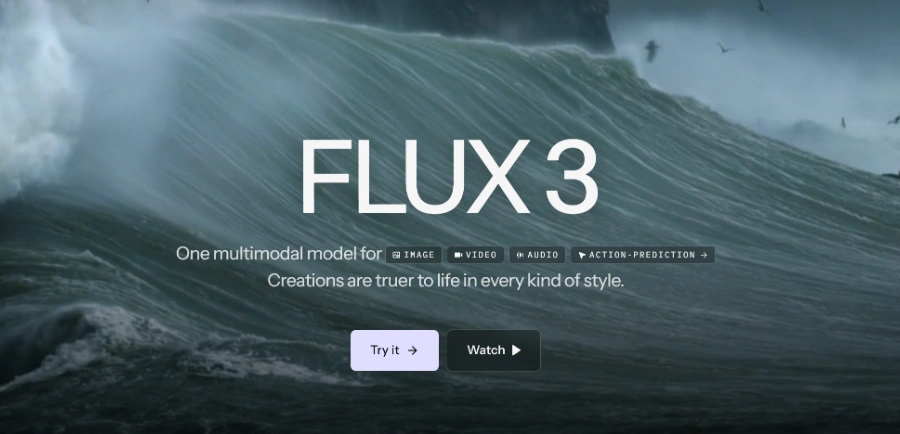
« A single AI model to create realistic images, videos up to 20 seconds long, and native audio. Video generation includes native multilingual audio: dialogue, sound effects, and ambient sound are produced directly alongside the images, without the need for separate post-processing »
FLUX 3 renders 20-second clips with dialogue, sound effects and lip-sync built in
Updated on August 8, 2026
FLUX 3 is Black Forest Labs' multimodal foundation model: one architecture trained jointly on images, video and audio, generating all three from the same weights. A single clip runs up to 20 seconds with its soundtrack, including multilingual dialogue and lip-sync. Billing works pay-as-you-go, per second of generated video, with no subscription attached. The same backbone also predicts robot actions, currently tested on production tasks at Audi.
Staged rollout: image model and open weights still pending
Benchmarks are vendor-reported, awaiting independent testing
Twenty seconds of picture and sound in one pass
FLUX 3 Video generates clips up to 20 seconds long in HD or Full HD, with an optional soundtrack created alongside the frames: lip-synced dialogue, sound effects and background ambience. The model takes a text prompt, a starting image, a video to continue, or keyframes to steer controlled transitions.
In practice, you describe an aerial push over a rainy city and the file lands with camera motion, drizzle and traffic hum already mixed. The output is not locked to a cinematic look either: home camcorder footage, animation and animated typography all sit within reach. Against other text-to-video models, its strongest card is that native audio, delivered at no extra charge.
The official FLUX 3 reveal from Black Forest Labs
Early-access CGI tests, text-to-video and image-to-video
From video to Audi's robots: the FLUX 3 rollout
Black Forest Labs is releasing FLUX 3 one capability at a time, all built from the same foundation model. Video shipped first, initially in early access and then generally available through the API; the image model and an open-weight Dev release follow, each after its own testing phase.
The strangest part of the package is FLUX-mimic. This video-action model, co-developed with mimic robotics, drives robot manipulation in under 80 ms on a single RTX 5090, and Audi is trialing it on real factory tasks. Generated footage and robot arms run on the same brain, which is the whole thesis of the lab.
Capability
What it produces
Where it stands
FLUX 3 Video
Clips up to 20 s with native audio
Available via the API and partners
FLUX 3 Image
Image generation and editing, multilingual text
Announced, rollout pending
FLUX 3 Dev
Downloadable open weights
Planned for a later stage
FLUX-mimic
Action prediction for robots
In testing with partners, including Audi
What FLUX 3 costs and how to get started
FLUX 3 is billed on usage alone, with no subscription or per-seat licence: 1 credit equals $0.01 and each video is charged per generated second, based on length, resolution (HD or FHD) and render type. Draft mode, HD only, comes in at roughly a third of a full render, handy for exploring variants before paying full price for the keeper.
Pricing stays identical between the playground and the API (a small mercy: no markup sneaks in between your tests and production). For the per-second figures themselves, the rate card on bfl.ai is the reference, and it moves as the rollout progresses.
No, FLUX 3 is billed on usage through a credit system, with no permanent free tier. There is no subscription: you pay for the seconds of video actually generated, and audio is included at no extra cost. An open-weight Dev release has been announced for a later stage, which will let you run the model on your own hardware.
Is FLUX 3 better than Kling or Seedance?
The only available numbers come from Black Forest Labs itself: in its human-preference tests on 10-second 720p clips, FLUX 3 won 93% of comparisons against Luma Ray 3.2, 77% against Runway Gen-4.5 and 60% against Kling v3 Pro, with a near coin flip against Seedance 2.0. Those results are preliminary and vendor-run, so treat them as a claim until third parties test it.
When will FLUX 3 Image and the open weights arrive?
The announced schedule places FLUX 3 Image after video, with the open-weight Dev release coming last. No firm dates have been published: every capability goes through an early-access phase with safety testing before general availability. Video generation, meanwhile, is already reachable through the API.
Does FLUX 3 support vertical video?
Yes, FLUX 3 sets its resolution bands by total pixels per frame rather than aspect ratio, so a vertical clip is treated like an equivalent 16:9 one. HD corresponds to about 1 megapixel per frame and FHD to 2 megapixels, while draft mode stays limited to HD.
Verdict: Twenty seconds of synced picture and sound per generation: that pitch speaks to ad studios, indie filmmakers and video teams building animatics, while developers can watch for the open-weight Dev release to bring the model onto their own machines.
To provide the best experiences, we use technologies such as cookies to store and/or access device information. Consenting to these technologies will allow us to process data such as browsing behavior or unique IDs on this site. Failure to consent or withdrawal of consent may adversely affect certain features and functions.
Functional
Always active
Storage or technical access is strictly necessary for the legitimate purpose of enabling the use of a specific service explicitly requested by the subscriber or Internet user, or for the sole purpose of transmitting a communication over an electronic communications network.
Preferences
Storage or technical access is necessary for the legitimate purpose of storing preferences that are not requested by the subscriber or person using the service.
Statistics
Storage or technical access used exclusively for statistical purposes.Storage or technical access which is used exclusively for anonymous statistical purposes. In the absence of a subpoena, voluntary compliance by your Internet service provider or additional third-party records, information stored or retrieved for this sole purpose generally cannot be used to identify you.
Marketing
Storage or technical access is necessary to create profiles of Internet users in order to send advertisements, or to track the Internet user on a website or on several websites with similar marketing purposes.
To provide the best experiences, we use technologies such as cookies to store and/or access device information. Consenting to these technologies will allow us to process data such as browsing behavior or unique IDs on this site. Failure to consent or withdrawal of consent may adversely affect certain features and functions.
Functional
Always active
Storage or technical access is strictly necessary for the legitimate purpose of enabling the use of a specific service explicitly requested by the subscriber or Internet user, or for the sole purpose of transmitting a communication over an electronic communications network.
Preferences
Storage or technical access is necessary for the legitimate purpose of storing preferences that are not requested by the subscriber or person using the service.
Statistics
Storage or technical access used exclusively for statistical purposes.Storage or technical access which is used exclusively for anonymous statistical purposes. In the absence of a subpoena, voluntary compliance by your Internet service provider or additional third-party records, information stored or retrieved for this sole purpose generally cannot be used to identify you.
Marketing
Storage or technical access is necessary to create profiles of Internet users in order to send advertisements, or to track the Internet user on a website or on several websites with similar marketing purposes.