Gradescope
#85 in Education / Studies
« Manage and mark all your tests, MCQs and exams efficiently, in class or online. Compatible with a wide range of school subjects »
Similar AI Tools
 Perplexity AI
  Notion AI
  QuillBot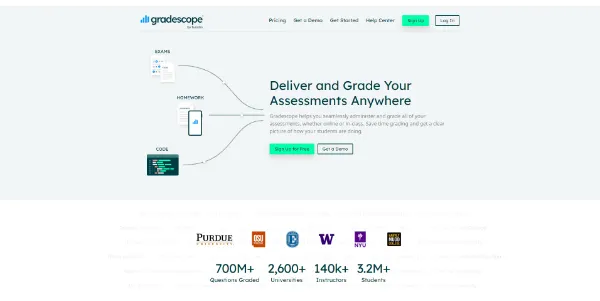


Updated on August 18, 2026
Gradescope is an AI-assisted grading platform for paper exams, online assignments and programming projects, adopted by over 2,600 universities. Rather than marking each paper individually, it groups similar answers so instructors score an entire batch at once. Turnitin has owned the platform since 2018, and a free Basic account gets a solo instructor started, with the AI features tied to an institutional license.
Gradescope grades in batches instead of one paper at a time. You scan a pile of exams, the platform splits every page by question, and for certain question types its AI gathers similar answers into suggested groups. You confirm each group, tick the rubric items once, and the score plus feedback lands on every matching paper. A chemistry instructor at San Francisco State reported marking ten questions for 250 students in about fifteen minutes.
One reassuring detail, the AI never assigns a grade on its own. It only proposes groupings, which you can merge, split or rebuild by hand before anything is scored. And the same logic stretches well past paper exams.
| Assignment type | How the platform handles it |
|---|---|
| Scanned paper exams | Per-question splitting, answer groups, on-screen annotation |
| Online assignments | Short and numeric answers scored automatically |
| Programming projects | Test-based autograder and code similarity reports |
| Bubble sheets | Automatic scoring as soon as scans are uploaded |
Gradescope started in 2014 at UC Berkeley, built by former teaching assistants tired of exam piles, among them robotics professor Pieter Abbeel. Turnitin, best known for its plagiarism detection tools, acquired the company in 2018. The platform now counts over 140,000 instructors, 3.2 million students and 700 million questions graded.
Day to day, a few guardrails make teaching teams stick around. Anonymous grading hides names to limit bias, students file regrade requests online, and rubrics can change mid-session (edit one criterion and every already-graded paper is rescored, a lifesaver when a question turns out ambiguous). Multiple graders can also work the same exam in parallel with shared rubrics, which keeps a five-TA team consistent.
Getting started costs nothing. The free Basic account covers PDF submissions, rubrics and regrade requests, no credit card required, and the first five instructors at any institution keep the team version free for good. AI-assisted answer grouping, LMS integration and detailed analytics require an institutional license, quoted case by case since Turnitin publishes no price list. On that tier, the official site claims grading time cut by 70% or more. Licensing terms shift over time, so treat the official pricing page as the final word.
Yes, a free Basic account exists for instructors, covering PDF submissions, rubric grading and regrade requests with no credit card. The heavier features, AI answer grouping, Canvas or Moodle integration and detailed analytics, require an institutional license that universities negotiate directly with Turnitin on a custom quote.
Only partially. Gradescope produces code similarity reports on programming assignments, which flags suspicious overlaps between student submissions. Written plagiarism checking and AI-writing detection are separate Turnitin products, not built into Gradescope itself, so many departments run both tools side by side when integrity is a concern.
Not automatically. Essays can be collected, annotated and scored with rubrics inside the platform, and anonymous grading works well for them, but the AI answer grouping is designed for short, structured responses like calculations, short text and multiple choice. Long-form writing still gets read and scored by a human.
According to Turnitin, the platform is SOC 2 and GDPR compliant, with single sign-on and LTI 1.3 connections to institutional learning systems. Universities typically cover usage through an institutional contract governing data handling. Submissions and grades stay visible only to the instructors and students enrolled in the relevant course.
Verdict: Two hundred midterms graded in a couple of evenings is the pitch, and it lands hardest for STEM instructors running large lecture courses with teaching assistant teams. Essay-heavy classes will keep humans on the long answers while Gradescope quietly absorbs everything structured around them.