Kaggle
#17 in Education / Studies
« A community platform focused on artificial intelligence. This site provides ML learning courses, models, code, a forum, etc. »
Similar AI Tools
 Perplexity AI
  Notion AI
  QuillBot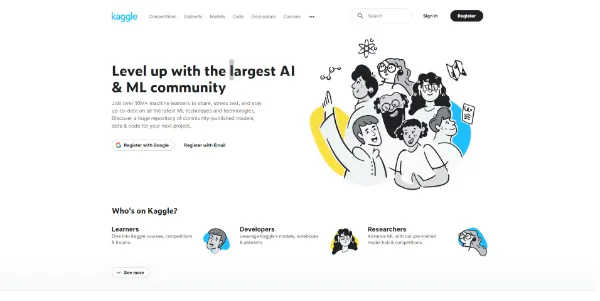

Updated on August 11, 2026
Kaggle is a Google-owned data science and machine learning platform: it hosts prize-money competitions, thousands of public datasets, browser-based notebooks and short courses with free certificates. Nothing costs a cent, including GPUs capped at 30 hours a week. The community has grown past 30 million members, from students to frontier research labs. Everything runs in English, which rarely slows anyone down since the real language here is Python.
Kaggle rests on three pillars: machine learning competitions posted by companies, public datasets to explore, and Jupyter notebooks that run online in Python or R. Founded in 2010 by Anthony Goldbloom, the platform joined Google in 2017 and has served as the training ground of the global data community ever since.
A competition fits in one sentence: an organization publishes a real problem with its data, you submit predictions, and a public leaderboard ranks everyone. Some contests hand out tens of thousands of dollars. Others only award medals, and those medals often carry more weight on a resume than the cash.
Kaggle hosts AI model evaluation benchmarks alongside its classic competitions, and the site now bills itself as the world's AI proving ground. With Community Benchmarks, anyone can design custom tests, run them against models from Google, Anthropic or DeepSeek within free quotas, then publish a leaderboard.
Hackathons follow the same open logic. A school or a company can set one up for free, with Kaggle funding up to $10,000 in prizes. Google DeepMind even ran a $200,000 benchmark-design contest on AGI there, a sign that major labs take the platform seriously.
A free account unlocks everything. You open a notebook, switch on a T4 or P100 GPU in the side panel, and training starts with zero setup (there can be a queue at peak times, so heavy jobs run best in the morning). The in-house courses, from Python to computer vision, take a few hours each and come with a certificate, a handy add-on to longer AI learning resources.
Compute quotas are predictable, a welcome change from free services that cut you off without warning. They do shift over time, though: Kaggle's official documentation is the reference for current numbers.
| Resource | Weekly quota | Max session |
|---|---|---|
| GPU (T4 or P100) | about 30 h | 12 h |
| TPU | about 20 h | 9 h |
| CPU | no weekly cap | 12 h |
| Working disk | 20 GB saved | persistent |
Yes, everything on Kaggle is free: competitions, datasets, notebooks, courses and certificates. GPU and TPU access is free too, within roughly 30 GPU hours and 20 TPU hours per week. There is no paid plan to extend those quotas; past that point, a standard cloud provider takes over.
Both give free GPU access. Kaggle stands on predictable quotas, its competitions and its community, while Colab sells Pro and Pro+ plans with stronger GPUs such as the A100. For building a public portfolio and learning alongside other practitioners, Kaggle keeps the edge.
Certificates prove practical basics, but recruiters pay far more attention to competition medals and platform ranks (Expert, Master, Grandmaster), which show results earned against other data scientists. A strong leaderboard finish regularly draws messages from headhunters.
It depends on each dataset: every one carries its own license, from the very permissive CC0 to research-only terms. Check the license box on the dataset page before any commercial use, because being published on Kaggle does not make data rights-free.
Verdict: Zero dollars from first notebook to certificate, plus 30 million members to measure yourself against: Kaggle remains the best training arena for data students, career changers and practitioners who want their models tested on real problems.

« An all-in-one creative platform that brings together more than 30 image and video models in a single interface. It includes camera controls that let you direct like a real filmmaker, characters that remain consistent from scene to scene, and ready-to-use tools for ads and short-form content »