GLM-5.3-Flash
#21 in LLM models
« The first natively multimodal model in the GLM-5 family, capable of observing interfaces and generating code based on what it sees, with a context of 1 million tokens at a very low cost
»




Updated on August 29, 2026
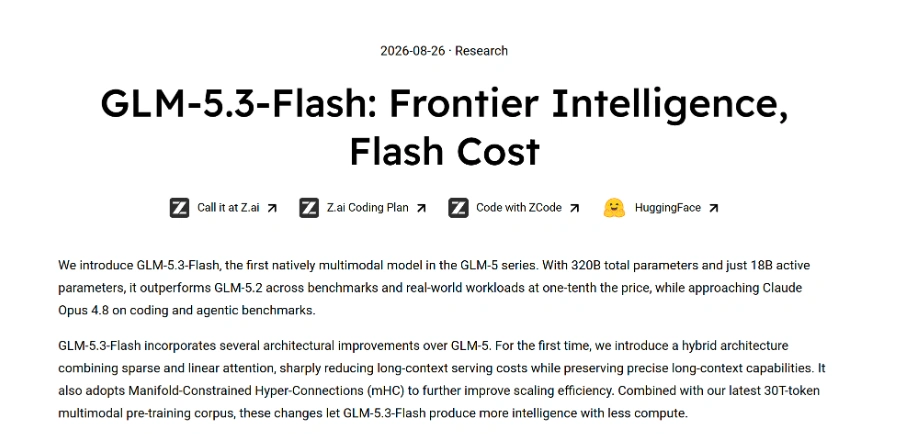
GLM-5.3-Flash is the first natively multimodal model in Z.ai's GLM-5 series, reading text, images and video inside a 1M-token context window. Before its official reveal it ran incognito as Ox Alpha on OpenRouter, where it became the busiest model of the week. The weights ship under the MIT License, and API rates start at 0.15 dollars per million input tokens. One extra twist, the entire stealth test was served on Chinese AI chips.
Z.ai tested GLM-5.3-Flash anonymously as ox-alpha on OpenRouter and OpenCode before claiming it. The point was honest feedback, free of any brand halo. The experiment snowballed, and the unnamed model finished as the most popular of the week on the platform (thousands of developers adopted it with no idea who had built it).
There is a hardware angle too, since all of that traffic was served on Chinese AI chips. Once the mask came off, the 320-billion-parameter model landed on Hugging Face as open weights under the MIT License.
GLM-5.3-Flash activates 18 billion of its 320 billion parameters per token and mixes sparse with linear attention to keep long-context serving affordable. It beats GLM-5.2 across benchmarks at a tenth of the price and comes close to Claude Opus 4.8 on Z.ai's internal Code Bench. On Terminal-Bench, GPT-5.6 Terra and Gemini 3.7 Flash stay ahead, though the gap has narrowed sharply. Its score of 57 on the Artificial Analysis Intelligence Index is easy to cross-check against a regularly updated LLM ranking.
In practice, the multimodal side changes how you work. You paste a screenshot of a broken dashboard, the model reads the layout and fixes the matching code.
Z.ai's free chat runs GLM-5.3-Flash with no credit card. On the API side, the list price sits at $0.15 per million input tokens, $0.50 for output and $0.03 for cached input, with a 50% launch discount trimming those figures during the first weeks. For scale, GLM-5.3 costs $1.40 and $4.40 on the same page. Rates in this market shift fast, so treat Z.ai's official pricing page as the only source worth quoting.
Several access routes coexist depending on your profile.
| Access | What you do there |
|---|---|
| chat.z.ai | Try the model for free in a browser |
| Z.ai API | Wire it into your apps, billed per token |
| GLM Coding Plan | Run it inside coding agents on a subscription |
| OpenRouter | Compare 17 providers serving the same model |
| Hugging Face | Download the open weights and fine-tune them |
No, the API is billed per token, but Z.ai's chat lets you try the model without paying. The fully free period was the anonymous Ox Alpha test, which ended at the official launch and was replaced by a temporary 50% discount on API rates.
Yes, Z.ai confirmed that the stealth model Ox Alpha, spotted on OpenRouter and OpenCode, was GLM-5.3-Flash. The blind test was designed to gather feedback without brand bias, and the model topped the platform's weekly usage charts before it even had a name.
Commercial use is permitted royalty-free, since the MIT License covers running, modifying and redistributing the weights published on Hugging Face. You can build it into a paid product or fine-tune it on private data, as long as the original license notice stays attached.
Locally, the FP8 checkpoint weighs around 306 GB before runtime overhead, so a multi-GPU server is the entry ticket. Quantized builds exist to shrink the bill. Below roughly 30 billion tokens a month, the API still works out cheaper than renting the hardware.
Verdict: Ten times cheaper than GLM-5.3 with coding results in the same neighborhood, this model suits developers running long agent loops on a metered budget, and tinkerers after credible open weights to host on their own terms.

« An all-in-one creative platform that brings together more than 30 image and video models in a single interface. It includes camera controls that let you direct like a real filmmaker, characters that remain consistent from scene to scene, and ready-to-use tools for ads and short-form content »