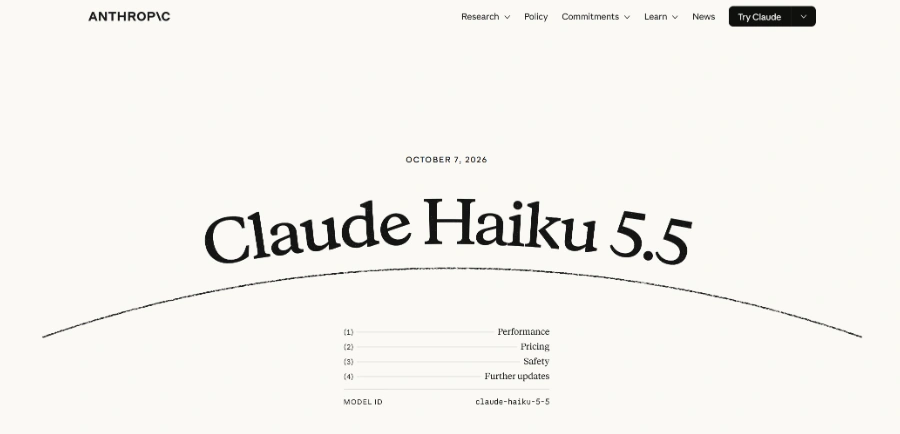
« The fastest and most affordable of the Claude 5 models, designed for high-volume tasks such as sorting, summarizing, or extracting information. This LLM prioritizes speed, low costs, and seamless use with browsers or tools »
Claude Haiku 5.5: Anthropic's cheapest model scores above GPT-6 Luna at one-tenth the old price
Updated on October 13, 2026
Claude Haiku 5.5 is Anthropic's small, fast model built for high-volume, cost-sensitive work such as summarization, classification, database queries and live customer support. Released on October 7, 2026, it rounds out the model family launched in 2023 alongside Opus 5.5 and Sonnet 5.5. API pricing starts at $0.10 per million input tokens for requests under 100,000 tokens, a 90% drop from Haiku 4.5. Max and Team subscribers also get monthly API credits that work on this model.
Pros
Input token price cut by 90% on short requests
First Haiku with adjustable effort levels
One-million-token context window
Cache reads down to $0.01 per million tokens
Day-one availability on four major clouds
Cons
Price jumps to $0.50/$2.50 above 100,000 tokens
Well behind Sonnet 5.5 on agentic coding
Official documentation only in English
Claude Haiku 5.5 vs GPT-6 Luna and Sonnet 5.5
According to Anthropic's published benchmarks, Haiku 5.5 outperforms GPT-6 Luna on every shared evaluation. The gap is widest on OSWorld 2.1 (desktop control), where Haiku scores 72.4% against Luna's 48.9%, and on Terminal-Bench 4.0 at 39.2% versus 16.4%. Artificial Analysis, an independent benchmarking firm, gives Haiku 5.5 an Intelligence Index score of 43 against 38 for Luna.
Sonnet 5.5 still leads comfortably on agentic coding (70.6% on Terminal-Bench versus 39.2%), which keeps Haiku in the role of a fast sub-agent rather than a standalone reasoning engine. Anthropic positions it as a subagent that pairs with Opus 5.5 and Sonnet 5.5 on coding work, handling the repetitive steps while the bigger model steers the plan, a pattern familiar to Claude Code users.
Benchmark
Haiku 5.5
GPT-6 Luna
Sonnet 5.5
GDPval-AA v2.1 (Elo)
1,620
1,437
1,840
OSWorld 2.1
72.4%
48.9%
83.9%
Terminal-Bench 4.0
39.2%
16.4%
70.6%
FrontierCode 1.1
46.4%
42.4%
52.1%
Chartography
46.4%
29.1%
61.6%
An enthusiastic hands-on test of Claude Haiku 5.5
Adjustable effort and real-world feedback
Haiku 5.5 is the first Haiku-class model with an effort dial. You can slide from low to max depending on whether speed or depth matters more for a given prompt, all without switching models.
Early enterprise feedback backs up the positioning. Asana reports over 30% less latency compared with the previous version. Box measured 11 quality points above Haiku 4.5 at roughly half the response time. Both cases highlight the same pattern of high-volume, short-prompt workloads benefiting from the price and speed gains.
API pricing and how to access the model
For requests up to 100,000 tokens, roughly 90% of traffic on the previous model according to Anthropic, the rate is $0.10 per million input tokens and $0.50 per million output tokens. Cache reads drop to $0.01. Above that threshold, prices rise to $0.50 and $2.50, still 50% below Haiku 4.5.
The model string is claude-haiku-5-5, available through the Anthropic API, Amazon Bedrock, Google Cloud and Microsoft Azure. Max and Team subscribers receive monthly API credits usable across all Claude models. Pricing is subject to change, so Anthropic's official page remains the authoritative reference.
On FrontierCode 1.1, Haiku 5.5 reaches 46.4%, above GPT-6 Luna's 42.4%. It handles quick fixes, prototyping and sub-tasks delegated by a larger model well. For complex refactors or long agentic chains, Sonnet 5.5 (70.6% on Terminal-Bench) or Opus 5.5 remain stronger picks based on published scores.
Claude Haiku vs Sonnet, which should you use?
Pick Haiku 5.5 at $0.10/$0.50 per million tokens for high-volume, short-prompt jobs like classification and summarization. Choose Sonnet 5.5 at $2/$10 when you need deeper reasoning or agentic coding. Terminal-Bench 4.0 illustrates the gap well, 39.2% for Haiku against 70.6% for Sonnet.
What is the difference between Claude Opus, Sonnet and Haiku?
Three tiers of capability and cost. Opus 5.5 ($4/$20 per million tokens) is the most powerful, followed by Sonnet 5.5 ($2/$10) for demanding tasks and Haiku 5.5 ($0.10/$0.50) for volume. On the GDPval-AA v2.1 Elo scale, they score roughly 1,846, 1,840 and 1,620 respectively.
Is Claude Haiku free, and how much does the API cost?
Anthropic has not published which Claude.ai plans include Haiku 5.5, so check the app for your tier. Through the API, it costs $0.10 per million input tokens and $0.50 per million output tokens for prompts up to 100,000 tokens. Longer prompts switch to a higher tier at $0.50/$2.50. Cache reads start at $0.01 per million tokens.
Verdict: Summarizing hundreds of documents, sorting tickets or driving a browser without blowing the API budget is exactly where Claude Haiku 5.5 earns its keep. Teams processing large volumes of short requests get a performance-to-price ratio that is hard to match, keeping Sonnet or Opus on standby for the heavy reasoning.
To provide the best experiences, we use technologies such as cookies to store and/or access device information. Consenting to these technologies will allow us to process data such as browsing behavior or unique IDs on this site. Failure to consent or withdrawal of consent may adversely affect certain features and functions.
Functional
Always active
Storage or technical access is strictly necessary for the legitimate purpose of enabling the use of a specific service explicitly requested by the subscriber or Internet user, or for the sole purpose of transmitting a communication over an electronic communications network.
Preferences
Storage or technical access is necessary for the legitimate purpose of storing preferences that are not requested by the subscriber or person using the service.
Statistics
Storage or technical access used exclusively for statistical purposes.Storage or technical access which is used exclusively for anonymous statistical purposes. In the absence of a subpoena, voluntary compliance by your Internet service provider or additional third-party records, information stored or retrieved for this sole purpose generally cannot be used to identify you.
Marketing
Storage or technical access is necessary to create profiles of Internet users in order to send advertisements, or to track the Internet user on a website or on several websites with similar marketing purposes.
To provide the best experiences, we use technologies such as cookies to store and/or access device information. Consenting to these technologies will allow us to process data such as browsing behavior or unique IDs on this site. Failure to consent or withdrawal of consent may adversely affect certain features and functions.
Functional
Always active
Storage or technical access is strictly necessary for the legitimate purpose of enabling the use of a specific service explicitly requested by the subscriber or Internet user, or for the sole purpose of transmitting a communication over an electronic communications network.
Preferences
Storage or technical access is necessary for the legitimate purpose of storing preferences that are not requested by the subscriber or person using the service.
Statistics
Storage or technical access used exclusively for statistical purposes.Storage or technical access which is used exclusively for anonymous statistical purposes. In the absence of a subpoena, voluntary compliance by your Internet service provider or additional third-party records, information stored or retrieved for this sole purpose generally cannot be used to identify you.
Marketing
Storage or technical access is necessary to create profiles of Internet users in order to send advertisements, or to track the Internet user on a website or on several websites with similar marketing purposes.



 Claude Opus 5.5
  GPT-6 Astra
  Claude Fable 5.1