

Google Search Goes Full AI: Agents, Mini-Apps, and the End of Ten Blue Links
All blog articles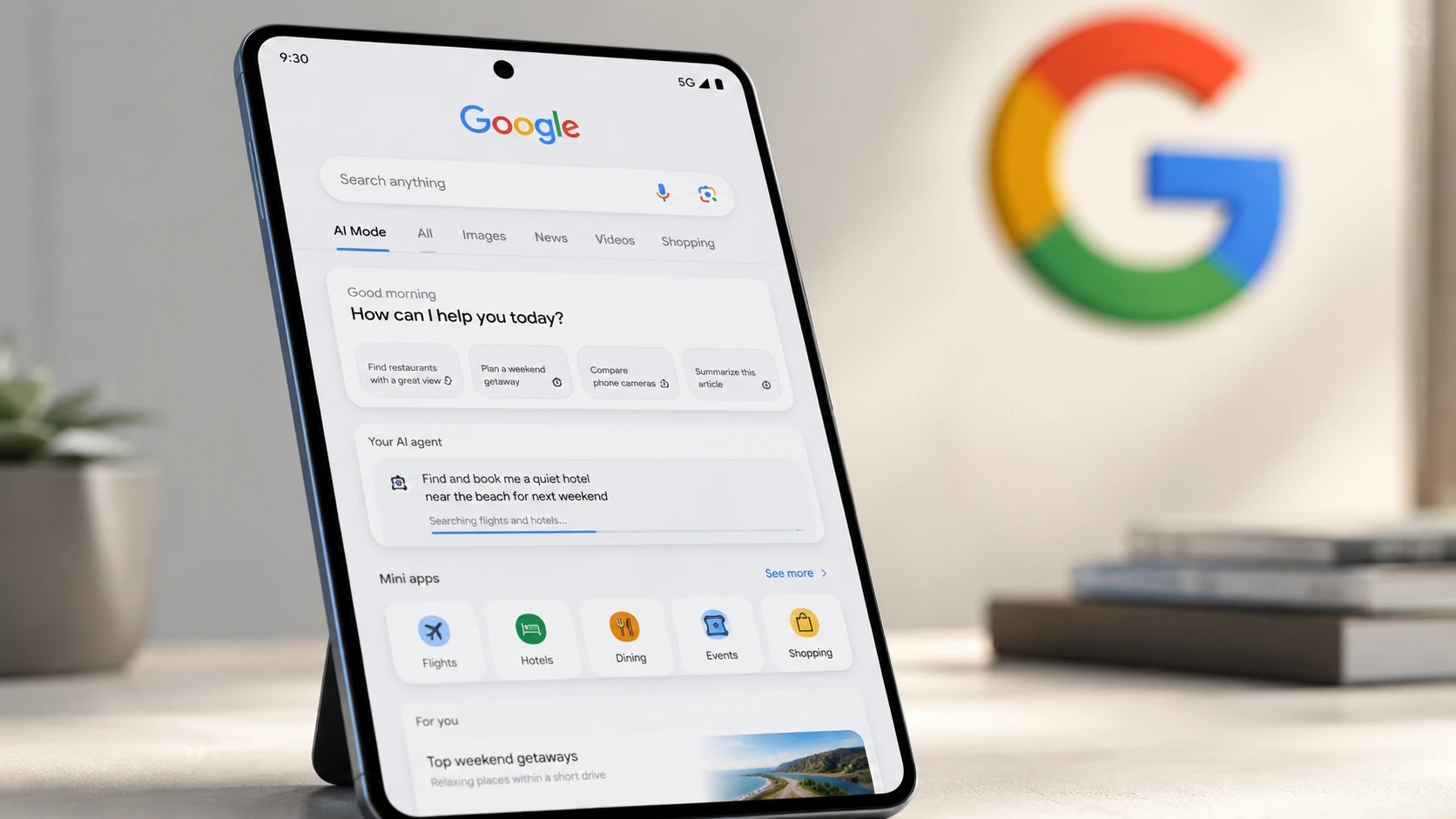
For 25 years, Google Search meant one thing: type keywords, get blue links, click one. That era ended on May 19 at Google I/O 2026. Sundar Pichai unveiled what the company calls the biggest upgrade to Search in over 25 years, and calling it an upgrade feels like calling a tsunami a wave.
Google Search gets a new AI-powered brain
The classic search box now dynamically expands to accept text, images, files, videos, and even open Chrome tabs. Gemini 3.5 Flash powers the new default AI Mode globally. Instead of returning ranked links, Search generates interactive dashboards, custom visualizations, and mini-apps built on the fly through Google Antigravity.
You can also ask follow-up questions directly from an AI Overview, flowing into a back-and-forth conversation. Context carries forward. Google wants Search to feel like talking to someone, not scanning a list.
Information agents: Google Alerts on steroids
The boldest feature is "information agents." These background AI workers monitor the web around the clock based on your criteria. Apartment hunting? Set your parameters and the agent scans listings continuously, alerting you when something matches.
Liz Reid, Google's head of Search, explained agents can also track financial markets with specific parameters. They launch this summer for Google AI Pro and Ultra subscribers first.
Staggering numbers and collateral damage
AI Mode crossed one billion monthly users in its first year. AI Overviews now reach 2.5 billion monthly users. For context, ChatGPT reported 900 million weekly active users earlier this year. Google's scale remains unmatched.
But publishers are paying the price. Zero-click searches account for roughly 58% of all Google queries. Ahrefs measured a 58% CTR drop for top-ranking pages on queries with AI Overviews. The EU's Digital Markets Act deadline for Google to share anonymized search data with rivals is July 27, 2026.
What this means for you and the open web
For everyday users, the promise is real: fewer tabs, less hunting, more answers delivered to you. For web publishers and small businesses, the math is brutal. Traffic from Google was already declining by a third in 2025, and these changes will accelerate that trend.
OpenAI and Perplexity are building conversational search alternatives. Yet with 2.5 billion monthly users, nobody matches Google's reach. The paradox is sharp: an AI that summarizes the web needs the web to exist. As we covered during our Google I/O 2026 preview, this conference was always going to be a turning point. Now we know the direction.