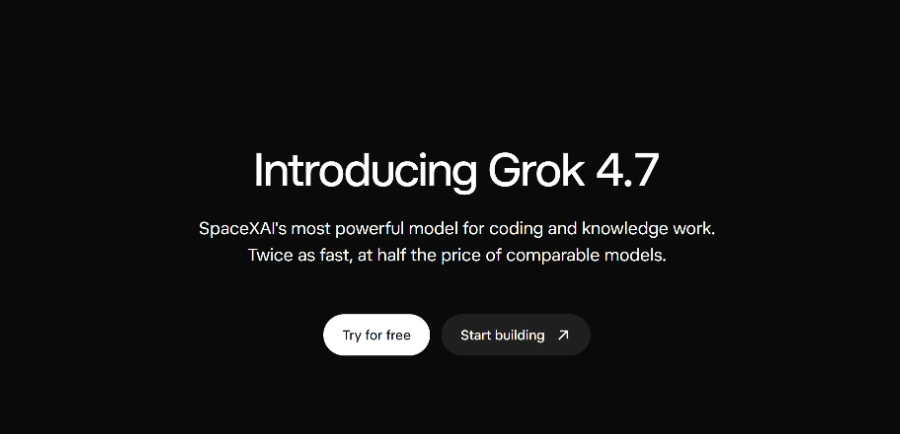
« A reasoning model that is twice as fast and half the cost, works longer on difficult tasks, checks its own work more thoroughly, and is highly resistant to attempts to circumvent it. It integrates easily with Cursor or via API »
Grok 4.7: a bigger base model, a 500k context, and the same old price
Updated on September 24, 2026
Grok 4.7 is SpaceXAI's frontier model for coding, agentic tasks and knowledge work, the direct successor to Grok 4.6. It landed one day before Claude Opus 5.5 and GPT-6 Sol, with API rates unchanged at $2 per million input tokens. The context window jumps to 500,000 tokens, with text and image input. You can also try it at no cost inside Grok Build, SpaceXAI's coding agent.
Pros
500,000-token context window for large repositories
Same API price as Grok 4.6
Free tier inside Grok Build
Four reasoning effort levels, including xhigh
Built-in web search, X search and code execution
Cons
Benchmarks self-reported by SpaceXAI so far
Token-hungry on long agentic jobs
Fast variant kept off the public API
Grok 4.7 vs Grok 4.6, what actually changed
Grok 4.7 runs on a larger base model than Grok 4.6, trained with a longer reinforcement learning run on tasks that take hours to finish. According to SpaceXAI, it checks its own work with greater care, holds very long context and natively understands the Grok Bot harness for conversational work. A rebuilt safeguard stack and cybersecurity capabilities round out the update.
In practice, you call the grok-4.7 identifier, pick one of four reasoning effort levels, and the Responses API returns encrypted reasoning so multi-turn sessions keep their train of thought without extra setup. Function calling, web search, X search and code execution come standard, with a knowledge cutoff of May 2026. Paste a whole repository into the context, describe the bug, and the agent gets going. The model is also available in Cursor, where a Fast variant doubles output speed.
Grok 4.7 tested head to head against its rivals
Is Grok 4.7 the cheapest frontier model around? A hands-on look
Self-reported benchmarks in a crowded launch week
SpaceXAI reports 71.0% on DeepSWE v1.1 and 46.3% on CursorBench 4.0, measured at the xhigh effort setting and published by the company founded in 2023 by Elon Musk under the xAI name. Independent measurements are still the missing piece.
Timing tells its own story. The model shipped one day ahead of Claude Opus 5.5, billed at $4 and $20 per million tokens, and GPT-6 Sol, at $2 and $10. The three do not sit the same exams, so crowning a winner would be premature, and the LLM ranking page helps track the pecking order week after week.
Benchmark
Reported score
What it measures
DeepSWE v1.1
71.0%
Software engineering
CursorBench 4.0
46.3%
Long-running coding tasks
Terminal-Bench 4.0
37.6%
Multi-hour terminal work
HealthBench Professional
56.7%
Professional health questions
Harvey Legal Agent Benchmark
19.6%
Agentic legal work
Grok 4.7 pricing, from free Grok Build to the API
The public API bills Grok 4.7 at $2 per million input tokens and $6 for output, identical to Grok 4.6. Grok 4.7 Fast, twice the speed at twice the rate, stays exclusive to Cursor and Grok Build, while Grok Build carries a free tier for the standard model. The grok-4.7 identifier is live on OpenRouter, Vercel and Cloudflare as well. Availability on grok.com and inside X, Premium and SuperGrok included, is not spelled out in the official pages, so check grok.com directly. Rates move around, and SpaceXAI's pricing page is the only figure worth quoting.
For an outside read on real-world speed and cost per finished job, measurement sites such as Artificial Analysis run their own meters (handy, since a cheap token that burns thousands of extra tokens stops being cheap rather quickly).
Grok 4.7 is SpaceXAI's frontier model for coding, agentic tasks and knowledge work, succeeding Grok 4.6. It takes text and images as input, handles a 500,000-token context window, and is served through the Grok API, Cursor, Grok Build, OpenRouter, Vercel and Cloudflare.
How much does Grok 4.7 cost?
On the API, it runs $2 per million input tokens and $6 per million output tokens, the same rates as Grok 4.6. The Fast variant costs double and only lives in Cursor and Grok Build. Consumer subscription prices on grok.com and X are best checked on grok.com directly.
What is the difference between Grok 4.7 and Grok 4.6?
A larger base model, a longer reinforcement learning run on harder tasks, better self-verification and stronger long-context handling, at the same price. SpaceXAI's documentation provides migration guides from Grok 4.6.
Grok 4.7 vs Claude Opus 5.5, which one should you pick?
Budget and your own test suite should decide. Opus 5.5, released the next day, is billed at $4 input and $20 output per million tokens, against $2 and $6 for Grok 4.7. The two companies publish different benchmarks, so the safest comparison is running both on your own repositories.
Verdict: Two dollars per million input tokens for a frontier model, the math practically writes itself. Cursor regulars, teams running coding agents around the clock and anyone following the model race will want Grok 4.7 on their test bench while independent numbers roll in.
To provide the best experiences, we use technologies such as cookies to store and/or access device information. Consenting to these technologies will allow us to process data such as browsing behavior or unique IDs on this site. Failure to consent or withdrawal of consent may adversely affect certain features and functions.
Functional
Always active
Storage or technical access is strictly necessary for the legitimate purpose of enabling the use of a specific service explicitly requested by the subscriber or Internet user, or for the sole purpose of transmitting a communication over an electronic communications network.
Preferences
Storage or technical access is necessary for the legitimate purpose of storing preferences that are not requested by the subscriber or person using the service.
Statistics
Storage or technical access used exclusively for statistical purposes.Storage or technical access which is used exclusively for anonymous statistical purposes. In the absence of a subpoena, voluntary compliance by your Internet service provider or additional third-party records, information stored or retrieved for this sole purpose generally cannot be used to identify you.
Marketing
Storage or technical access is necessary to create profiles of Internet users in order to send advertisements, or to track the Internet user on a website or on several websites with similar marketing purposes.
To provide the best experiences, we use technologies such as cookies to store and/or access device information. Consenting to these technologies will allow us to process data such as browsing behavior or unique IDs on this site. Failure to consent or withdrawal of consent may adversely affect certain features and functions.
Functional
Always active
Storage or technical access is strictly necessary for the legitimate purpose of enabling the use of a specific service explicitly requested by the subscriber or Internet user, or for the sole purpose of transmitting a communication over an electronic communications network.
Preferences
Storage or technical access is necessary for the legitimate purpose of storing preferences that are not requested by the subscriber or person using the service.
Statistics
Storage or technical access used exclusively for statistical purposes.Storage or technical access which is used exclusively for anonymous statistical purposes. In the absence of a subpoena, voluntary compliance by your Internet service provider or additional third-party records, information stored or retrieved for this sole purpose generally cannot be used to identify you.
Marketing
Storage or technical access is necessary to create profiles of Internet users in order to send advertisements, or to track the Internet user on a website or on several websites with similar marketing purposes.



 GPT-6 Astra
  Claude Fable 5.1
  Claude Fable 5