Fal AI
#130 in Developer Tools
« A cloud platform for easy deployment of AI models. Easily integrate computer vision and language processing into your web and mobile applications »
Similar AI Tools
 GPT-5.3-Codex
  Claude Code
  Cursor AI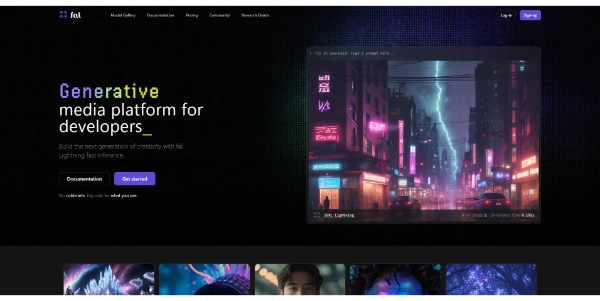


Updated on August 13, 2026
Fal AI is an inference platform for generative media, serving over 1,000 models for image, video, audio and 3D through a single API. Trial credits come with sign-up, no card required, and after that every generated output is billed on its own, with no subscription. Adobe, Canva, Shopify and Perplexity all run production workloads on it. Behind the curtain sit thousands of Nvidia GPUs and an in-house engine claimed to run up to 10x faster than standard setups.
Fal AI hosts over 1,000 production-ready models, from text-to-image models like FLUX and Seedream to video engines such as Kling, Veo, Wan and Seedance, plus speech, music and 3D. In practice, you swap one line of code and your app switches generators without touching any infrastructure.
Speed does the rest. The in-house inference engine is claimed to run up to 10x faster than a plain GPU deployment, with 99.99% uptime and warm models answering almost instantly, all built on serverless computing so nobody babysits an autoscaler. The company reports capacity beyond 100 million inference calls a day. Three building blocks make up the platform.
| Building block | What you run | Who it suits |
|---|---|---|
| Model APIs | Catalog models, billed per output | Apps and prototypes |
| fal Serverless | Your own models or pipelines on the same engine | Teams with custom models |
| fal Compute | Dedicated Nvidia H100, H200 and B200 GPUs | Training and fine-tuning |
| Playground | Any model, tested in the browser | Scouting before integration |
Around three million developers work with Fal AI, and teams at Adobe, Canva, Shopify, Perplexity and Quora rely on it to power generative features. The GPUs heat up, your servers stay cool.
Backstage, the company was founded in 2021 by two former Coinbase and Amazon engineers, Burkay Gur and Gorkem Yurtseven. In late 2025 a $140 million Series D led by Sequoia, with Nvidia joining the round, valued it at $4.5 billion (its third raise that year, a pace few startups match). By early 2026 the trade press reported talks for a fresh round near $8 billion, still unconfirmed, and AWS became its preferred cloud partner.
Access to Fal AI starts with promotional credits at sign-up, no card required. From there the platform runs on prepaid credits, and only successful generations are charged, never server errors or time spent in the queue. Image models typically bill per image or per megapixel, video models per second of footage, and everything else per request or per GPU-second. Rates shift as models come and go, so treat the official pricing page as the only reliable reference.
The path from idea to production is short. You create an account through GitHub or Google, test a model in the playground, generate an API key, then wire up the Python or JavaScript SDK. A first image can land within minutes of signing up.
No, not permanently. Promotional credits are granted at sign-up so you can test models without a card, but there is no ongoing free tier. After that, every image, second of video or request draws from prepaid credits. Each model lists its own rate on its page, and prices change often, so the official pricing page is the reference.
Both platforms host pay-as-you-go models. Fal AI focuses on inference speed and near-zero cold starts, which matters for real-time, customer-facing apps. Replicate lines up a longer tail of niche models, with latency that can climb on less popular ones. For a product where response time is the priority, Fal AI keeps the edge.
Enterprise customer data is not used to train fal models, according to the company's enterprise materials. Its terms also state that customers keep the rights to their inputs, subject only to the license required to operate the service. For sensitive projects, the enterprise tier adds private hosting, SSO and SLA-backed support.
Partly, yes. The playground lets you run any catalog model straight from the browser, which is enough to compare generators or produce a few test renders. The real value sits in the API and SDKs though, so a production project calls for someone comfortable with Python or JavaScript.
Verdict: One API key instead of a dozen vendor accounts, and zero GPUs to manage. Product teams, studios and startups wiring image or video generation into an app will find the shortest route to production here, while the playground gives less technical profiles a place to experiment.