Semantic Scholar
#7 in Search engine
« Explore 220 million scientific publications with a semantic AI search engine and a powerful API for developers »
Similar AI Tools
 Perplexity AI
  SearchGPT
  Liner AI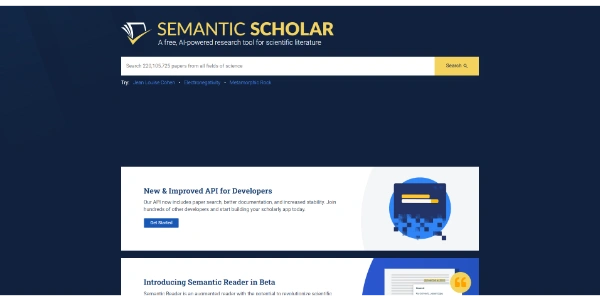


Updated on August 8, 2026
Semantic Scholar is an AI-powered academic search engine: it reads the meaning of scientific papers and ranks results by relevance and influence rather than keyword frequency. Everything is free, from search to the API, with no paid tier anywhere. The tool comes from Ai2, the non-profit institute founded by Microsoft co-founder Paul Allen, and has been running since 2015. Over 230 million publications sit in the index, from arXiv preprints to peer-reviewed journals.
The engine relies on natural language processing models that extract what a paper actually says instead of counting keywords. Every result carries a TLDR, a one-sentence AI-generated summary: you type three words on your topic and the results page scans like a science newswire. These capsules do the same job as AI summarization tools, applied here to an entire corpus.
Citation handling is the other house specialty. References get classified by type (background, method, result) and the highly influential ones are flagged automatically, which changes how you judge a paper's real weight. Semantic Reader, still in beta, pins a card for each cited reference in the margin of the PDF (a quiet cure for the fifteen-open-tabs habit).
Google Scholar ranks largely by citation count, which pushes old and already famous work to the top. Semantic Scholar bets on a different signal: what a paper actually contributed to the studies citing it. When you map a research field or hunt for studies that challenge a founding result, the difference shows within the first few queries.
And with a free account, the personal layer kicks in:
All the underlying data is open to developers at no charge. The REST API serves papers, authors and citations as JSON; an API key, also free, raises the rate limits for heavier workloads. Enough to build a monitoring pipeline or enrich bibliographies without a budget line.
A quick tour of the ecosystem, because it goes well beyond the search box:
| Resource | What it is | Typical use |
|---|---|---|
| Web engine | Search across 230+ million papers | Day-to-day literature review |
| REST API | Papers, authors and citations as JSON | Monitoring scripts and apps |
| S2AG | The full academic graph as metadata | Bibliometrics, network analysis |
| S2ORC | 8.1 million open access papers, structured text | Text mining and NLP research |
Yes, completely. Search works without an account or sign-up, and no feature sits behind a paywall: TLDR summaries, Semantic Reader, research feeds, alerts and the API are all included. The service is funded by Ai2, the non-profit research institute founded by Paul Allen, and has stayed subscription-free since its 2015 launch.
They complement each other rather than compete. Google Scholar casts a wider net but ranks mostly by citation counts, which favors older papers. Semantic Scholar adds TLDR summaries, influence-ranked citations and personalized recommendations: for quickly sizing up the recent literature of a field, it saves real time.
The API is free, with shared rate limits for anonymous calls and dedicated quotas once you request a key, also at no cost. The academic graph metadata is built for reuse by developers; some publisher-sourced content remains governed by its own licenses, so check the terms against the nature of your project.
Only partly. The platform indexes metadata, abstracts and open access PDFs, and its S2ORC corpus bundles 8.1 million open access papers with structured full text. Paywalled articles appear in results with their summaries and citation data, but reading them still requires publisher access, typically through a university library.
Verdict: PhD students, master's candidates and science journalists get literature triage of a rare precision for a service that never sends an invoice; for full text behind publisher paywalls, your library's institutional access remains the natural companion.

« An all-in-one creative platform that brings together more than 30 image and video models in a single interface. It includes camera controls that let you direct like a real filmmaker, characters that remain consistent from scene to scene, and ready-to-use tools for ads and short-form content »