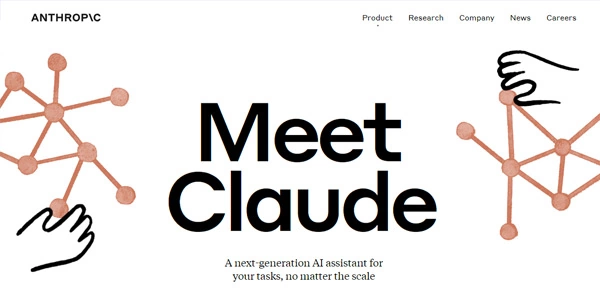
« Anthropic's conversational AI assistant that writes, codes, analyzes documents, and browses the web. It can also remember your preferences from one conversation to the next »
Claude AI: free plan, Pro or Max, the full guide to Anthropic's assistant
Updated on September 18, 2026
Claude AI is the conversational assistant from Anthropic, a San Francisco company founded in 2021 by former OpenAI researchers, including siblings Dario and Daniela Amodei. A free plan covers chat, web search, memory and voice mode, while Pro costs $20 per month ($17 billed annually). The model range is headed by Claude Fable 5.1, alongside Opus 5, Sonnet 5 and Haiku 4.5. Apps run on the web, Windows, macOS, iOS and Android.
Pros
1 million token context window on top models
Free plan with web search, memory and voice mode
Ecosystem covers terminal, Chrome browser and Excel
Strong reputation for writing quality and code
Cons
No built-in image generation
Free plan limits arrive fast under heavy use
Fable 5.1 and Opus 5 limited to paid plans
Fable 5.1, Opus 5, Sonnet 5 and Haiku 4.5, the Claude model range
Four models power Claude, each with a clear role. Fable 5.1, the most capable, targets ambitious coding, long-running agents and scientific research, available from the Pro plan upward. Opus 5 is the recommended pick for most tasks, Sonnet 5 handles everyday work and Haiku 4.5 goes for speed. Fable, Opus and Sonnet support a context window of 1 million tokens. You drop a 300-page report into the chat, ask three questions, and the summary lands (a whole codebase fits too, nobody is judging).
A quick word about the name. It is widely read as a reference to Claude Shannon, the father of information theory, though Anthropic has never settled the question publicly. The company also steers its models with a public Constitution, the backbone of its safety approach.
Model
Strong point
Access
Fable 5.1
Complex coding, long-running agents
Pro and above
Mythos 5.1
Cybersecurity, life sciences
Approved organizations
Opus 5
Recommended for most tasks
Pro and above
Sonnet 5
Daily work, long documents
From the free plan
Haiku 4.5
Fast answers at low cost
From the free plan
A complete walkthrough of Claude AI in 2026, from first prompt to daily workflow
Claude Code, Cowork, Chrome, an ecosystem well past the chat window
The Claude ecosystem reaches from the terminal to the browser, with desktop and mobile apps on every major platform.
Rivals keep their own strengths, of course. In the crowded market for AI chat assistants, ChatGPT holds on to image generation and its GPT catalog, Google Gemini leans on Google's services, Mistral Le Chat plays the European card and Perplexity bets on sourced search. Claude built its name on careful writing and code, to the point that plenty of developers have made it their daily tool.
Claude Code, the coding agent living in your terminal
Claude Cowork, automation for files and repetitive tasks
From the free plan to Max, what a subscription costs
Claude starts at $0 with a Free plan that includes chat, web search, memory, voice mode, artifacts and file creation. Pro costs $20 per month, or $17 billed annually, and adds Opus 5, Fable 5.1, Claude Code, Cowork, Claude Design, the Research feature and unlimited projects. Max begins at $100 per month for five to twenty times the usage of Pro, higher output limits and early access to new features. Team runs $20 per seat billed annually ($25 monthly), Enterprise starts at $20 per seat billed annually with usage-based costs on top.
On the API side, Haiku 4.5 bills at $1 per million input tokens, Sonnet 5 at $2, Opus 5 at $5 and Fable 5.1 at $10, with output priced five times higher. These figures shift as new models ship, so the official pricing page is the only number that counts on the day you subscribe.
Yes, Claude has a free plan with no credit card required, including chat, web search, memory, voice mode and the Sonnet 5 and Haiku 4.5 models. Quotas reset on rolling windows and shrink fast during intense sessions, which is where the Pro subscription takes over.
Claude AI vs ChatGPT, which should you pick?
ChatGPT remains stronger on multimedia, with built-in image generation, while Claude leads on long documents, careful writing and code. Many professionals keep both. If your work revolves around text and large files, Claude gets the edge thanks to its very large context window.
Who owns Claude AI?
Anthropic, a San Francisco company founded in 2021 by former OpenAI members, including siblings Dario and Daniela Amodei, develops and owns Claude. Its safety approach is formalized in a public Constitution that shapes model behavior. The first name is usually traced back to mathematician Claude Shannon.
How do you download Claude AI?
Desktop apps exist for Windows and macOS, mobile apps for iOS and Android, on top of the web version at claude.ai. Computers get the app from the official site, phones from the App Store or Google Play. One account keeps conversations and projects in sync everywhere.
Verdict: Long-form writing, document analysis and programming form the triangle where Claude shines, and the free plan lets you check that without a credit card. Anyone chasing generated images will simply pair it with a dedicated tool.
To provide the best experiences, we use technologies such as cookies to store and/or access device information. Consenting to these technologies will allow us to process data such as browsing behavior or unique IDs on this site. Failure to consent or withdrawal of consent may adversely affect certain features and functions.
Functional
Always active
Storage or technical access is strictly necessary for the legitimate purpose of enabling the use of a specific service explicitly requested by the subscriber or Internet user, or for the sole purpose of transmitting a communication over an electronic communications network.
Preferences
Storage or technical access is necessary for the legitimate purpose of storing preferences that are not requested by the subscriber or person using the service.
Statistics
Storage or technical access used exclusively for statistical purposes.Storage or technical access which is used exclusively for anonymous statistical purposes. In the absence of a subpoena, voluntary compliance by your Internet service provider or additional third-party records, information stored or retrieved for this sole purpose generally cannot be used to identify you.
Marketing
Storage or technical access is necessary to create profiles of Internet users in order to send advertisements, or to track the Internet user on a website or on several websites with similar marketing purposes.
To provide the best experiences, we use technologies such as cookies to store and/or access device information. Consenting to these technologies will allow us to process data such as browsing behavior or unique IDs on this site. Failure to consent or withdrawal of consent may adversely affect certain features and functions.
Functional
Always active
Storage or technical access is strictly necessary for the legitimate purpose of enabling the use of a specific service explicitly requested by the subscriber or Internet user, or for the sole purpose of transmitting a communication over an electronic communications network.
Preferences
Storage or technical access is necessary for the legitimate purpose of storing preferences that are not requested by the subscriber or person using the service.
Statistics
Storage or technical access used exclusively for statistical purposes.Storage or technical access which is used exclusively for anonymous statistical purposes. In the absence of a subpoena, voluntary compliance by your Internet service provider or additional third-party records, information stored or retrieved for this sole purpose generally cannot be used to identify you.
Marketing
Storage or technical access is necessary to create profiles of Internet users in order to send advertisements, or to track the Internet user on a website or on several websites with similar marketing purposes.



 ChatGPT
  Gemini AI
  Grok 4