

Nvidia's Hot Tub Cooling Trick Could Slash Data Center Water Use to Zero
All blog articles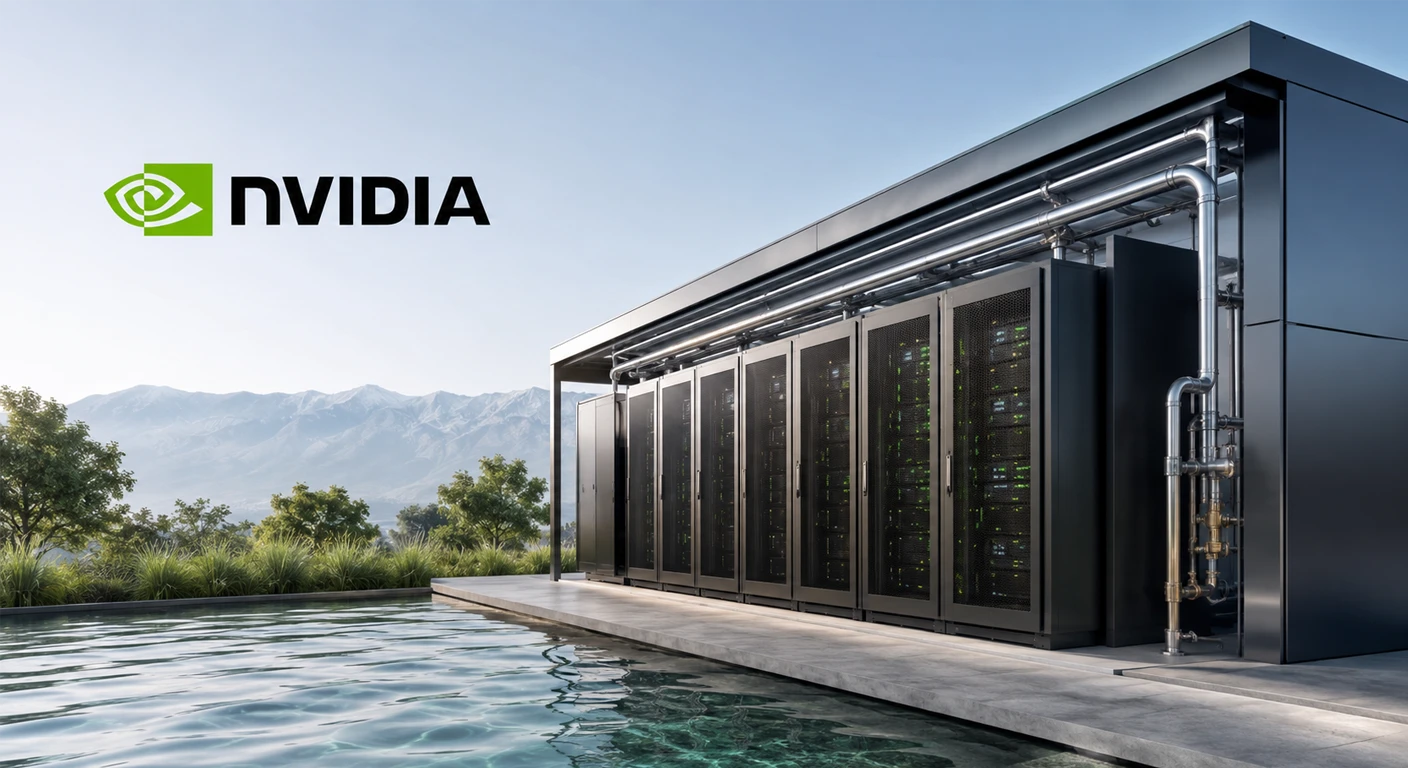
A mid-size AI data center drinks roughly 300,000 gallons of water per day just to stay cool. Nvidia says it can bring that number to near zero, and the secret runs hotter than your hot tub.
Nvidia's warm-water cooling system explained
Unveiled at London Climate Week on June 22, the design uses a closed-loop coolant (75% water, 25% propylene glycol) that enters server racks at 45 °C (113 °F) and exits at 55 °C. That temperature gap is wide enough for passive outdoor radiators to dump the heat without evaporative cooling, fans, or chillers.
The loop is filled once and sealed for the lifetime of the facility. No top-ups, no water trucks, no evaporation losses. Nvidia's chief sustainability officer Josh Parker told Axios the water challenge for data centers is "largely solved."
Why hotter coolant means lower data center costs
Traditional chiller systems keep coolant around 21-24 °C and eat up to 40% of a data center's electricity bill. Every 1 °C bump in target temperature saves roughly 4% on cooling energy. Going from 24 °C to 45 °C is, well, a lot of saved watts.
Nvidia estimates a 50 MW hyperscale site could pocket over $4 million a year. Microsoft has already said it is evaluating the system for next-gen Azure AI clusters. When your two biggest cloud partners are interested, the market tends to follow.
Over 75 data center projects blocked in early 2026
Here is the real pressure behind the announcement. More than 75 data center builds worth $130 billion were delayed or killed in early 2026 due to community pushback over water and energy use. A cooling system that eliminates on-site water consumption is not just green PR; it is a permit-unlocking tool.
The water problem beyond the data center walls
Nvidia draws its accounting boundary at the facility door. Power plants supplying electricity still gulp water: natural gas uses about 1.17 liters per kWh, coal around 2.2. The IEA projects fossil fuels will cover over 40% of new data center power demand through 2030.
As TechCrunch noted, Nvidia's fix addresses roughly a quarter to a third of the total water footprint. Real progress, not a silver bullet. Still, the direction is right, and the rest of the industry now has a benchmark to beat.