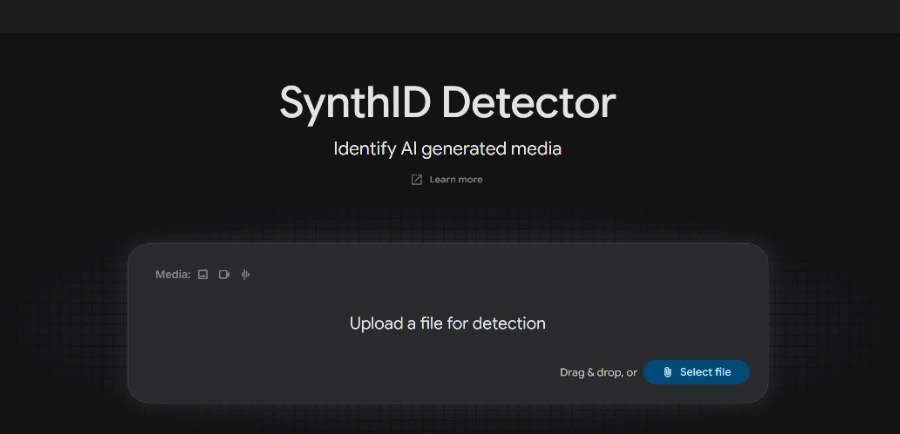
« Check if an image, video, or audio file was generated by AI and contains an invisible watermark. The system recognizes compatible content even after it has been edited or compressed »
SynthID Detector: Google DeepMind's free portal to spot AI watermarks in images, video and audio
Updated on October 13, 2026
SynthID Detector is Google DeepMind's verification portal that checks whether an image, video or audio file carries a SynthID watermark. After a restricted beta for journalists and researchers in 2025, the tool opened to everyone on October 7, 2026 at synthid.com. No payment is required; you sign in with a Google account or a third-party account such as Apple, under a daily quota that Google does not publish. The interface is English-only for now.
Pros
Reads watermarks from Google, OpenAI, NVIDIA and Kakao outputs
Handles images, video and audio in one place
Highlights exact segments carrying the watermark
No subscription or fee at sign-up
Uploaded files deleted right after the result
Cons
English-only interface
Limited to SynthID-marked content, not a general AI detector
Daily verification quota per account
How SynthID Detector reads an invisible watermark
SynthID Detector reads an invisible mark embedded in the file at generation time by a compatible model. You upload your file on synthid.com, the portal scans it and returns a two-word verdict: watermark detected, or not detected. For video and audio, it goes further by pinpointing the specific segments that carry the mark.
The watermark lives inside the pixel values or audio waveforms themselves, not in metadata, so it survives cropping, compression and common filters. One caveat worth remembering, though: a negative result proves nothing. The content may come from a model that does not apply SynthID, or it may have been altered heavily enough to erase the signal.
SynthID Detector explained in a few minutes
Partners and file formats on SynthID Detector
Google has watermarked more than 180 billion images and videos and the equivalent of 240,000 years of audio since the technology debuted in 2023. The portal now reaches well beyond Google's own products. OpenAI, NVIDIA and Kakao embed SynthID in their models, and Apple is listed as joining soon.
SynthID checks are also built into Google Search, the Gemini app and Chrome, handling over one million requests a day
Apple is announced as the next partner
File type
Accepted formats
Result shown
Image
JPG, PNG, WEBP, AVIF, HEIC, TIFF, GIF, BMP
Watermark detected or not
Video
MP4, MOV, WEBM
Segments carrying the watermark
Audio
WAV, MP3, OGG, FLAC, AAC, M4A
Segments carrying the watermark
Who benefits from this watermark detector
Journalists fact-checking a suspicious clip, teachers running a media-literacy exercise, platform moderators screening uploads and communications teams vetting assets before publication all get a quick first pass. A teacher, for instance, can upload an image in class and spark a discussion on digital provenance in under a minute.
Keep in mind that the portal does not replace a broader AI content detector. SynthID only reads its own signature. A file produced by Midjourney, Stable Diffusion or any model without SynthID will slip through. Google recommends cross-referencing multiple signals and uploading the highest-quality version of the file you can find.
SynthID embeds an imperceptible signal directly into the pixel values of an image, the frames of a video or the waveform of an audio file during generation. This digital watermark survives common edits like compression, cropping and color filters. The detector at synthid.com then compares the uploaded file against the expected pattern to confirm or deny the watermark's presence.
How do you check if an image has a SynthID watermark?
Go to synthid.com, sign in with a Google account or a third-party account such as Apple, and upload the file. The portal returns a result in seconds, telling you whether a SynthID watermark was found. For video and audio, it also highlights the specific segments that carry the mark. For best accuracy, submit the least compressed version of the file available.
Does ChatGPT use SynthID?
Yes for watermarked content, since the portal's official FAQ lists OpenAI among the companies that have adopted SynthID, alongside NVIDIA and Kakao. Google does not spell out which OpenAI products apply the watermark or since when, and text generated by ChatGPT is not covered by the portal, which only handles images, video and audio.
Can a SynthID watermark be removed?
The signal is engineered to withstand everyday edits such as cropping, compression and filters. Google itself says the watermark is not infallible and that someone trying many transformations may find one that escapes detection. Google also notes that a negative detection result does not prove a file is human-made; the watermark may have been damaged, or the source model may not use SynthID at all.
Verdict: A suspicious image or clip can be checked in under a minute at no cost. Journalists, educators and content moderators gain a solid first filter, as long as they remember it covers only SynthID partner outputs, not every AI generator on the market.
To provide the best experiences, we use technologies such as cookies to store and/or access device information. Consenting to these technologies will allow us to process data such as browsing behavior or unique IDs on this site. Failure to consent or withdrawal of consent may adversely affect certain features and functions.
Functional
Always active
Storage or technical access is strictly necessary for the legitimate purpose of enabling the use of a specific service explicitly requested by the subscriber or Internet user, or for the sole purpose of transmitting a communication over an electronic communications network.
Preferences
Storage or technical access is necessary for the legitimate purpose of storing preferences that are not requested by the subscriber or person using the service.
Statistics
Storage or technical access used exclusively for statistical purposes.Storage or technical access which is used exclusively for anonymous statistical purposes. In the absence of a subpoena, voluntary compliance by your Internet service provider or additional third-party records, information stored or retrieved for this sole purpose generally cannot be used to identify you.
Marketing
Storage or technical access is necessary to create profiles of Internet users in order to send advertisements, or to track the Internet user on a website or on several websites with similar marketing purposes.
To provide the best experiences, we use technologies such as cookies to store and/or access device information. Consenting to these technologies will allow us to process data such as browsing behavior or unique IDs on this site. Failure to consent or withdrawal of consent may adversely affect certain features and functions.
Functional
Always active
Storage or technical access is strictly necessary for the legitimate purpose of enabling the use of a specific service explicitly requested by the subscriber or Internet user, or for the sole purpose of transmitting a communication over an electronic communications network.
Preferences
Storage or technical access is necessary for the legitimate purpose of storing preferences that are not requested by the subscriber or person using the service.
Statistics
Storage or technical access used exclusively for statistical purposes.Storage or technical access which is used exclusively for anonymous statistical purposes. In the absence of a subpoena, voluntary compliance by your Internet service provider or additional third-party records, information stored or retrieved for this sole purpose generally cannot be used to identify you.
Marketing
Storage or technical access is necessary to create profiles of Internet users in order to send advertisements, or to track the Internet user on a website or on several websites with similar marketing purposes.



 Undetectable AI
  PimEyes
  FaceCheck ID