What Beats Rock
#17 in Games
« Play against an AI in this game inspired by Rock-Paper-Scissors. Anticipate your opponent's move to score points. Simple rules, fun gameplay »
Similar AI Tools
 Chessnut
  AI Town
  Infinite Craft By Neal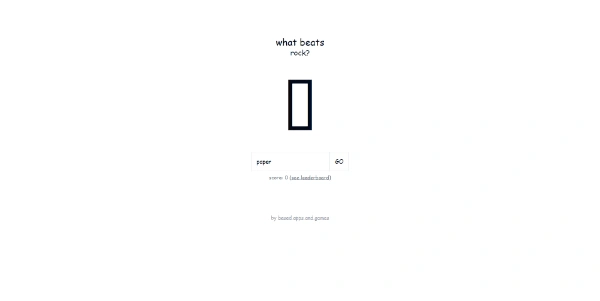


Updated on September 6, 2026
What Beats Rock is a free browser game where an AI decides whether your answer logically defeats the previous one, starting from a plain rock. Paper, dynamite, black holes, heartbreak, anything can win as long as the reasoning holds up. Developers Khoi Le and Kyle Gian launched it in July 2024 and it went viral within days on Twitter. No account, no download, you type and you argue.
Every run opens with the same challenge, find something that defeats a rock. You type an idea, a large language model rules on it within seconds, then backs its verdict with a snarky one-liner and an emoji. Classic rock-paper-scissors stops at three moves, while here the chain keeps going as long as your logic holds.
An accepted answer becomes the next thing to topple, and your score climbs by one. The game also shows how many people tried the same idea before you. Careful, reusing a word from the current run ends the streak on the spot. You type lava, the rock melts, and a brand-new problem stares back at you.
| Classic answer | Reasoning the AI accepts |
|---|---|
| Paper | It covers the rock |
| Water | It erodes the rock |
| Time | It wears the rock down |
| Diamond | It cuts the rock |
The game came out in July 2024 and blew up almost overnight, after one of its makers shared a few chains on Twitter. Players often mention Infinite Craft in the same breath, another AI-powered browser toy, or Human or Not, the Turing test turned into a game, yet the argued duel against a sarcastic referee remains this game's signature.
The records say a lot about how addictive it gets. Community-documented solo chains sit between 80 and 120 answers, collaborative runs have passed 150, and some custom variants have logged scores above 100,000.
Playing costs nothing at whatbeatsrock.com, with no sign-up and no install. An account stays optional and mainly opens up three things.
One practical warning before you start. (The quick five-minute session has a habit of swallowing an entire lunch break, plan accordingly.)
Yes, the game is completely free in the browser, with no download, no mandatory account and no hidden fees. Opening whatbeatsrock.com is enough to start a run within seconds. Signing up stays optional and only unlocks the weekly leaderboard, custom variants and chain sharing.
No, an internet connection is required. Each answer is judged in real time by a language model, so nothing can be evaluated without a network. On phones, the mobile browser works fine and no app is required, as long as you have signal.
Repeating a word already used in the current run counts as a loss and resets your score to zero. The AI remembers the whole session and judges near-duplicates strictly, which is why rotating between objects, natural forces and abstract concepts pays off over long chains.
An account is all it takes to build a variant around your own starting question. The most played community versions get featured on the homepage, from food battles to size contests, and record hunters compare their runs on Discord.
You should not need one. The official game at whatbeatsrock.com runs in any browser with nothing to install, so it usually loads fine on school or work computers unless the network blocks the domain itself. Unofficial unblocked copies exist, but they rely on a different AI judge and rarely match the original's rulings, leaderboard and custom variants.
Verdict: Five minutes to grasp the rule, weeks before it gets old. Teachers after a logic warm-up, coworkers on a break and fans of absurd debates with a stubborn machine will keep coming back.