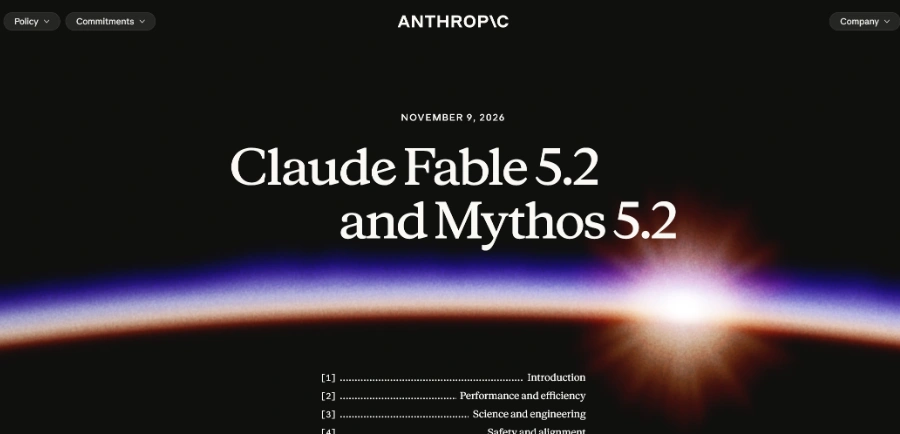
Claude Fable 5.2: Anthropic's frontier model at $8/M tokens with 49% on FrontierCode and multi-hour agents
Updated on November 10, 2026
Claude Fable 5.2 is Anthropic's most capable large language model available to the general public, released on November 9, 2026 alongside its restricted counterpart Claude Mythos 5.2. API pricing sits at $8 per million input tokens and $40 per million output tokens, a 20% reduction from Fable 5.1. The model targets coding, finance, scientific research and long-horizon agent orchestration. No free plan grants access; a Pro subscription ($20/mo), Max, Ultra, Team, Enterprise or an API key is required.
Pros
Up to 30% faster output than Fable 5.1
One-million-token context window
Optional fast mode up to 2.5x standard speed
Multi-hour sub-agent orchestration built in
20% API price cut over the previous generation
Cons
No access on the free Claude plan
Token cost is double that of Opus 5.5
Site and documentation available in English only
Claude Fable 5.2 in action: code, science and agents
Fable 5.2 and Mythos 5.2 share the same underlying model. Fable adds cyber and biology safeguards, making it available to every paying subscriber, while Mythos stays locked behind Anthropic's verification programs. According to Anthropic, Fable 5.2 blocks roughly 55% fewer queries than Fable 5.1 (about 60% fewer in cyber, 40% in biology). Blocked requests fall back to Opus 4.8 or Opus 5 automatically.
Benchmarks published by Anthropic paint a clear picture: 49.1% on FrontierCode 2.0 at its highest effort setting, ahead of Opus 5.5 (45.5%), GPT-6 Astra (42.8%) and Gemini 4 Carbon (41.1%). On Terminal-Bench-Science the model reaches 74.6%, and a swarm of 1,000 Fable 5.2 agents formalized the proof of Fermat's Last Theorem in Lean in 30 hours, down from 11 days for the first attempt.
Fable 5.2 does not dominate everywhere. Gemini 4 Carbon leads on AutomationBench (53.9% vs 51.4%), and Opus 5.5 keeps a higher Elo on the AA-Briefcase office-work test (1,800 vs 1,785) at half the token price. Anthropic itself recommends starting with Opus 5.5 for everyday work and stepping up to Fable only when the problem demands it.
Official Anthropic demo of Claude Fable 5.2
A former Claude skeptic puts Fable 5.2 to the test
API and subscription pricing
The prices below are the dollar figures published by Anthropic at launch. They may change; always check the official pricing page.
Pro ($20/mo): Fable access through usage credits, limited quota
Max ($100/mo) and Ultra ($200/mo): Fable included up to half of weekly limits
Team Standard ($25/seat/mo) and Team Premium ($125/seat/mo)
Enterprise ($20/seat/mo annual, 20-seat minimum, usage billed at API rates)
Mode
Input ($/M tokens)
Output ($/M tokens)
Standard
8
40
Fast mode
16
80
Batch API (−50%)
4
20
Cache (read)
0.20
—
Opus 5.5 (comparison)
4
20
Anthropic heads toward Nasdaq
Anthropic filed its S-1 with the SEC on October 26, 2026, then amended it on November 2 to include third-quarter revenue of $16.96 billion, according to the filing. The planned ticker is ANT on the Nasdaq Global Select Market. Valuation expectations, initially floated at roughly $2 trillion, were walked down by investors: Bloomberg reported on November 6 a range of $1.2 to $1.3 trillion, with some buyers as low as $1.1 trillion.
Fable 5.2's release falls squarely in that window, as Bloomberg reported that Anthropic could begin its IPO roadshow as early as the week of November 9, a timeline the company has not confirmed. Among competing LLM models, GPT-6 Astra and Gemini 4 Carbon remain the closest rivals; each outperforms Fable 5.2 on at least one benchmark, keeping the choice firmly task-dependent.
Claude Fable 5.2 is Anthropic's most capable publicly available model, released November 9, 2026. It shares the same base as Mythos 5.2 but includes cyber and biology safeguards. With a one-million-token context window and 128K-token max output, it targets advanced coding, finance, scientific research and multi-hour agent orchestration.
How much does Claude Fable 5.2 cost?
Standard API pricing is $8 per million input tokens and $40 per million output tokens, 20% below Fable 5.1. Fast mode doubles that to $16/$80, and the batch API halves it to $4/$20. On claude.ai, Max ($100/mo) and Ultra ($200/mo) include Fable up to half of weekly limits, while Pro uses usage credits.
Is Claude Fable 5.2 free, and does Claude Max include it?
No free access exists. The Free plan excludes Fable entirely. Max ($100/mo) and Ultra ($200/mo) include it up to half the weekly usage limit. Pro subscribers can use it through usage credits. At launch, eligible paid subscribers received one to three extra Fable quota resets depending on account history.
Claude Fable 5.2 vs Opus 5.5: which should you pick?
Anthropic recommends Opus 5.5 ($4/$20) for most tasks and Fable 5.2 for the hardest problems. Fable leads on FrontierCode 2.0 (49.1% vs 45.5%) and Remote Labor Index (41.3% vs 21.3%), but Opus 5.5 edges ahead on AA-Briefcase Elo (1,800 vs 1,785) at half the per-token cost. Start with Opus, escalate to Fable when the difficulty warrants double the spend.
Verdict: At $8 per million input tokens and top-of-chart coding benchmarks according to Anthropic, Fable 5.2 earns its place on the shortlist of developers, R&D teams and analysts tackling problems that Opus 5.5 cannot crack alone.
To provide the best experiences, we use technologies such as cookies to store and/or access device information. Consenting to these technologies will allow us to process data such as browsing behavior or unique IDs on this site. Failure to consent or withdrawal of consent may adversely affect certain features and functions.
Functional
Always active
Storage or technical access is strictly necessary for the legitimate purpose of enabling the use of a specific service explicitly requested by the subscriber or Internet user, or for the sole purpose of transmitting a communication over an electronic communications network.
Preferences
Storage or technical access is necessary for the legitimate purpose of storing preferences that are not requested by the subscriber or person using the service.
Statistics
Storage or technical access used exclusively for statistical purposes.Storage or technical access which is used exclusively for anonymous statistical purposes. In the absence of a subpoena, voluntary compliance by your Internet service provider or additional third-party records, information stored or retrieved for this sole purpose generally cannot be used to identify you.
Marketing
Storage or technical access is necessary to create profiles of Internet users in order to send advertisements, or to track the Internet user on a website or on several websites with similar marketing purposes.



 Claude Opus 5.5
 Gemini 4 Carbon
 GPT-6 Astra