« A multimodal model with 552B parameters, of which only 8B are active at the input stage, featuring native visual understanding and accessible via API for your applications. This open-source model uses a Causal Encoder-Decoder architecture to respond to your text and image queries »
DeepSeek-V4.1-Flash: 552 billion parameters, just 8 billion awake to read your prompt
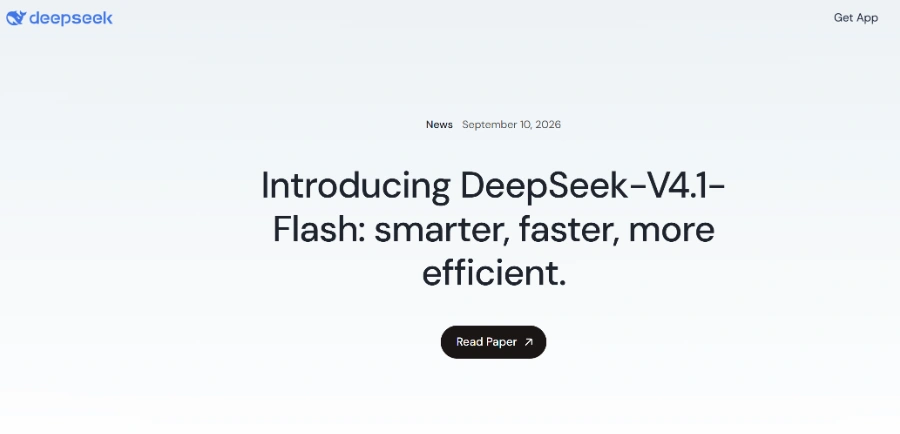
DeepSeek-V4.1-Flash is the open multimodal language model from Chinese lab DeepSeek, the first built on a new architecture with native image understanding and a one-million-token context window. Released on September 10, 2026 under an MIT license, its weights download freely from Hugging Face. On the API, off-peak input runs $0.15 per million tokens, with cached input dropping to $0.003. Coding agents, terminal work and long-document analysis are its home turf.
Pros
One-million-token context window
MIT-licensed open weights, commercial use permitted
Native image input, trained in from day one
Cached-input rate among the lowest on the market
Fast output, around 214 tokens per second
Cons
Raw reasoning trails Claude Opus 5 and GPT-5.6 Sol
Self-hosting calls for hundreds of GB of GPU memory
Fairly verbose when reasoning effort is dialed up
Causal encoder-decoder, the asymmetric design under the hood
The Causal Encoder-Decoder architecture debuting here activates 8 billion parameters to read your prompt and 16 billion to write the answer, out of 552 billion total arranged as a mixture of experts. Reading is cheaper than generating, a deliberate choice for agents that swallow huge contexts.
The other lever is the KV cache, squeezed down to 890 bytes per token, roughly a quarter of the previous Flash generation. Agents that reread the same repository or system instructions all day pay far less (that cache line is where most of an agent bill quietly hides).
1,048,576-token context, up to 384,000 completion tokens
Reasoning effort dial adjustable from 1 to 100
Trained from scratch on 45 trillion multimodal tokens
Native vision, images and text learned together from pre-training
The new architecture explained and the model put through real tests
Running the open MIT weights on local hardware
DeepSeek-V4.1-Flash against Claude Opus 5 and GPT-5.6 Sol
On the launch benchmarks, V4.1-Flash beats its own bigger sibling V4-Pro across most coding and agent tests, which is why DeepSeek made it the default model of its API. Against the American heavyweights, the picture is more mixed.
It snatches first place on DeepSWE and Automation-Bench, then gives ground as soon as tool-free reasoning is involved. To place those scores in the current pecking order, a regularly updated ranking of language models keeps things in perspective.
Benchmark
V4.1-Flash
Claude Opus 5
GPT-5.6 Sol
DeepSWE v1.1
74.2
74.0
73.0
Automation-Bench
54.8
50.3
45.8
Terminal-Bench 3.0
30.0
43.3
34.4
Humanity's Last Exam
36.8
56.3
44.5
What DeepSeek-V4.1-Flash costs, peak versus off-peak
The API charges $0.15 per million input tokens and $0.60 per million output tokens off-peak, with peak hours doubling both figures. A cached input token falls to $0.003 per million, a floor rarely seen anywhere.
Peak windows run 01:00 to 04:00 and 06:00 to 10:00 UTC on weekdays, everything else is off-peak. Schedule your heavy agent jobs for the weekend and the bill shrinks by half. The model name to set is deepseek-flash, and third-party hosts serve it too, OpenRouter first among them. DeepSeek adjusts its rate card often, so treat the official pricing page as the only source that counts.
The weights are free to download on Hugging Face under an MIT license, commercial use included. The official API bills per token, with off-peak rates at half price. In between, third-party hosts such as OpenRouter serve it pay-as-you-go, with no subscription required.
Can you run DeepSeek-V4.1-Flash locally?
Yes, with serious hardware. At 552 billion parameters, plan on roughly 300 GB of GPU memory in 4-bit quantization, so a multi-GPU server rather than a laptop. Below very high volumes, the API or a third-party host works out far cheaper than self-hosting.
What happens to DeepSeek-V4-Pro?
DeepSeek first announced that V4-Pro requests would route to V4.1-Flash from September 14, 2026, then reversed course. The lab now keeps the V4-Pro API running with unchanged billing until a future V4.1-Pro arrives as the next flagship.
Does DeepSeek-V4.1-Flash match Claude Opus 5 or GPT-6?
On agent and coding tasks it plays in the same league at a fraction of the price. On tool-free reasoning it sits behind, scoring 40 on the Artificial Analysis Intelligence Index against 53 for GPT-6 Astra and Claude Fable 5.1 at maximum reasoning effort.
Verdict: An agent rereading the same repository all day costs a fortune elsewhere and next to nothing here. Teams running high-volume coding or automation agents get one of the best intelligence-per-dollar ratios available, keeping a heavyweight reasoning model on standby for the thorniest problems.
To provide the best experiences, we use technologies such as cookies to store and/or access device information. Consenting to these technologies will allow us to process data such as browsing behavior or unique IDs on this site. Failure to consent or withdrawal of consent may adversely affect certain features and functions.
Functional
Always active
Storage or technical access is strictly necessary for the legitimate purpose of enabling the use of a specific service explicitly requested by the subscriber or Internet user, or for the sole purpose of transmitting a communication over an electronic communications network.
Preferences
Storage or technical access is necessary for the legitimate purpose of storing preferences that are not requested by the subscriber or person using the service.
Statistics
Storage or technical access used exclusively for statistical purposes.Storage or technical access which is used exclusively for anonymous statistical purposes. In the absence of a subpoena, voluntary compliance by your Internet service provider or additional third-party records, information stored or retrieved for this sole purpose generally cannot be used to identify you.
Marketing
Storage or technical access is necessary to create profiles of Internet users in order to send advertisements, or to track the Internet user on a website or on several websites with similar marketing purposes.
To provide the best experiences, we use technologies such as cookies to store and/or access device information. Consenting to these technologies will allow us to process data such as browsing behavior or unique IDs on this site. Failure to consent or withdrawal of consent may adversely affect certain features and functions.
Functional
Always active
Storage or technical access is strictly necessary for the legitimate purpose of enabling the use of a specific service explicitly requested by the subscriber or Internet user, or for the sole purpose of transmitting a communication over an electronic communications network.
Preferences
Storage or technical access is necessary for the legitimate purpose of storing preferences that are not requested by the subscriber or person using the service.
Statistics
Storage or technical access used exclusively for statistical purposes.Storage or technical access which is used exclusively for anonymous statistical purposes. In the absence of a subpoena, voluntary compliance by your Internet service provider or additional third-party records, information stored or retrieved for this sole purpose generally cannot be used to identify you.
Marketing
Storage or technical access is necessary to create profiles of Internet users in order to send advertisements, or to track the Internet user on a website or on several websites with similar marketing purposes.