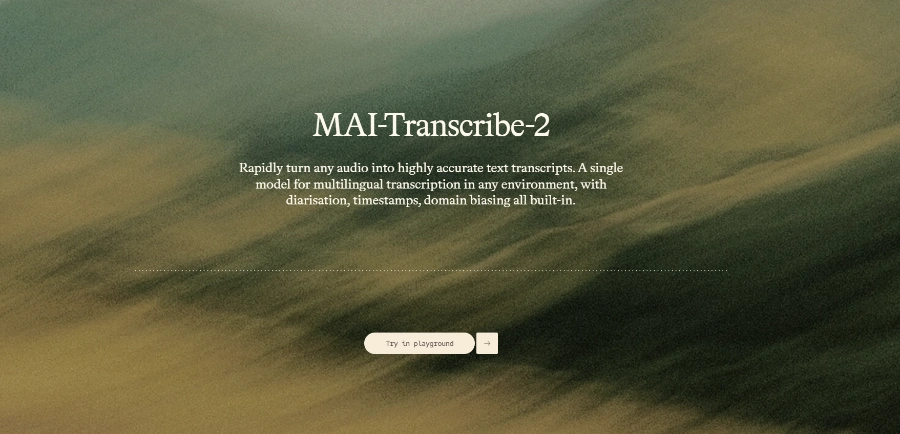
« A transcription model that converts audio to text, even in challenging acoustic conditions, with diarization and support for over 60 languages. Add your industry-specific terms to improve recognition of specialized vocabulary. »
MAI-Transcribe-2: an hour of audio transcribed for 10 cents, across 60 languages
MAI-Transcribe-2 is Microsoft AI's in-house speech-to-text model, converting audio into text across 60 languages. Released on September 3, 2026 in public preview, it is priced at $0.10 per hour of audio, a launch rate that lasts until the end of 2026. At release it topped the multilingual FLEURS benchmark. One useful caveat, this is an API for developers rather than an app you install.
Pros
Topped the FLEURS benchmark at launch across 60 languages
Speaker diarization and word-level timestamps included by default
Up to 10x faster on long recordings
Launch price of $0.10 per audio hour
Keyword biasing for industry jargon and proper names
Cons
Still in public preview, no service-level agreement
Built for developers, no ready-made consumer app
Files capped at 300 MB or two hours
Speaker labels, word timestamps and your own jargon
MAI-Transcribe-2 separates the people talking in a recording, attributes each sentence to the right voice and stamps every word with precise timing. You upload a four-person steering call, you get back a labeled transcript ready for search, quotes or subtitles.
Language detection is automatic, and the model follows conversations that flip between two languages mid-sentence (Hinglish, the Hindi-English blend, appears in Microsoft's own demos). The company also pitches it as the listening layer for voice AI tools, paired with its MAI-Voice-2 Flash speech model on the output side.
Keyword biasing, feed it product names and jargon to sharpen recognition
Verbatim style, every filler word kept for compliance and analysis
Clean style, readable text with the ums stripped out
MAI-Transcribe-2's launch and 72% price cut, explained
MAI-Transcribe-2 against Whisper, GPT-Transcribe and Scribe v2
On the multilingual FLEURS benchmark, MAI-Transcribe-2 took first place at launch with a 5.2% average word error rate across 60 languages, ahead of Whisper-Large-V3, OpenAI's GPT-Transcribe, ElevenLabs' Scribe v2 and Google's Gemini 3.5 Transcribe. Independent tester Artificial Analysis also clocked it at up to ten times the speed of rivals on long recordings.
Three releases in five months, that is the pace of this family. Microsoft is building its own speech recognition stack in-house, step by step reducing its reliance on OpenAI's models.
Version
Released
Languages
Highlights
MAI-Transcribe-1
April 2026
25
launched at $0.36 per hour
MAI-Transcribe-1.5
June 2026
43
keyword biasing, faster processing
MAI-Transcribe-2
September 2026
60
diarization, timestamps, output styles
What MAI-Transcribe-2 costs and where to try it
MAI-Transcribe-2 costs $0.10 per hour of audio, a limited-time rate valid through December 31, 2026. The first generation launched at $0.36, so the cut reaches 72%. For context, Artificial Analysis lists Scribe v2 around $0.22 per hour, GPT-Transcribe near $0.27 and Gemini 3.5 Transcribe close to $0.30.
Access runs through Microsoft Foundry with an Azure account (free to create, no small print there), through the MAI Playground for code-free tests, or via OpenRouter. Since the January price remains unannounced, double-check the official page before locking in next year's budget.
No, it costs $0.10 per hour of audio, a promotional rate through the end of 2026. Creating an Azure account is free, and the MAI Playground lets you test the model without writing code. Microsoft has not yet published the standard rate that will follow.
MAI-Transcribe-2 vs Whisper, which should you pick?
Whisper remains the open-source option you can self-host, handy when audio must stay on your own machines. On the FLEURS benchmark, MAI-Transcribe-2 posts a lower word error rate than Whisper-Large-V3 and ships with diarization and timestamps built in, features Whisper does not provide on its own.
Can you use MAI-Transcribe-2 in production?
Microsoft labels it a public preview without a service-level agreement, so production workloads are officially discouraged for now. Worth knowing, MAI-Transcribe-1 was deprecated five months after release, so plan migration windows if you build on this model family.
What file formats and sizes does it accept?
WAV, MP3 and FLAC files, up to 300 MB or two hours each. Word-level timestamps and speaker labels are switched on through API parameters, and diarization in enhanced mode supports shorter recordings than plain transcription does.
Verdict: No consumer app here, just an API to wire in. Developers and data teams processing multilingual audio at scale get labeled transcripts for roughly a third of rival rates, and the MAI Playground makes the first test painless.
To provide the best experiences, we use technologies such as cookies to store and/or access device information. Consenting to these technologies will allow us to process data such as browsing behavior or unique IDs on this site. Failure to consent or withdrawal of consent may adversely affect certain features and functions.
Functional
Always active
Storage or technical access is strictly necessary for the legitimate purpose of enabling the use of a specific service explicitly requested by the subscriber or Internet user, or for the sole purpose of transmitting a communication over an electronic communications network.
Preferences
Storage or technical access is necessary for the legitimate purpose of storing preferences that are not requested by the subscriber or person using the service.
Statistics
Storage or technical access used exclusively for statistical purposes.Storage or technical access which is used exclusively for anonymous statistical purposes. In the absence of a subpoena, voluntary compliance by your Internet service provider or additional third-party records, information stored or retrieved for this sole purpose generally cannot be used to identify you.
Marketing
Storage or technical access is necessary to create profiles of Internet users in order to send advertisements, or to track the Internet user on a website or on several websites with similar marketing purposes.
To provide the best experiences, we use technologies such as cookies to store and/or access device information. Consenting to these technologies will allow us to process data such as browsing behavior or unique IDs on this site. Failure to consent or withdrawal of consent may adversely affect certain features and functions.
Functional
Always active
Storage or technical access is strictly necessary for the legitimate purpose of enabling the use of a specific service explicitly requested by the subscriber or Internet user, or for the sole purpose of transmitting a communication over an electronic communications network.
Preferences
Storage or technical access is necessary for the legitimate purpose of storing preferences that are not requested by the subscriber or person using the service.
Statistics
Storage or technical access used exclusively for statistical purposes.Storage or technical access which is used exclusively for anonymous statistical purposes. In the absence of a subpoena, voluntary compliance by your Internet service provider or additional third-party records, information stored or retrieved for this sole purpose generally cannot be used to identify you.
Marketing
Storage or technical access is necessary to create profiles of Internet users in order to send advertisements, or to track the Internet user on a website or on several websites with similar marketing purposes.