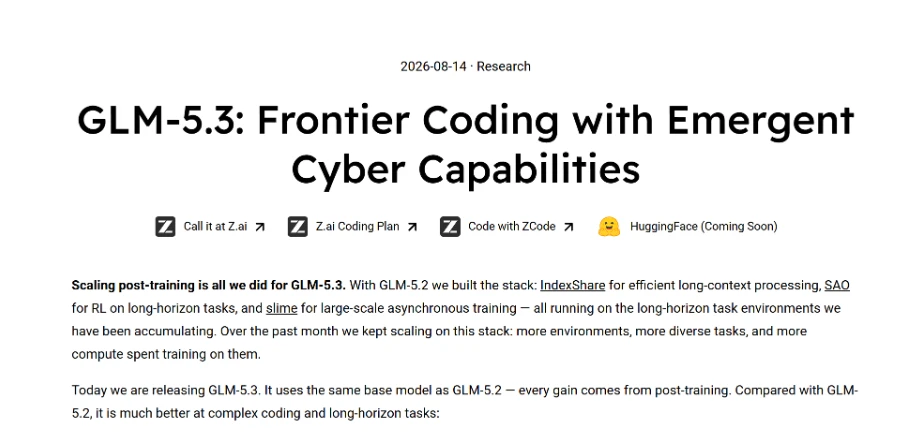
« A long-term coding and agent model based on GLM-5.2, featuring enhanced training, a 1-million-token context, and always-active reasoning that can be adjusted across three levels. This LLM stands out for its performance in logical reasoning and semantic understanding. »
GLM-5.3: Z.ai multiplies its command-line score by six without changing the base model
Updated on August 22, 2026
GLM-5.3 is a large language model from Z.ai, the lab formerly known as Zhipu AI, built for complex software engineering, long-horizon agent work and security analysis. Its Terminal-Bench 3.0 score grew sixfold over GLM-5.2 without a single change to the base model, purely through scaled post-training. You pay per token on the API or take a flat GLM Coding Plan subscription. Open weights were announced for Hugging Face once a safety review wraps up.
Pros
Tops open models on Terminal-Bench 3.0
1-million-token context window
Fewer output tokens per completed task than GLM-5.2
Plugs into Claude Code, Codex, Cline and OpenCode
Cons
Reasoning cannot be switched off, which adds latency
Weights announced but not downloadable yet
Vendor-reported benchmarks still await independent checks
GLM-5.3, same base as GLM-5.2, everything decided in post-training
GLM-5.3 reuses the GLM-5.2 base, a mixture of experts architecture at roughly 743 billion parameters with a 1-million-token context window, and draws every gain from post-training at scale. On Z.ai's internal coding bench, the improvement over GLM-5.2 reaches 50%.
The training recipe swaps short coding drills for simulated workstations, complete with codebases, documentation, testing tools and multi-step assignments, the kind where an agent must spot a bottleneck in an ML training stack, fix it, then prove the speedup. Public numbers back the approach.
Efficiency moved too. At max effort the model completes 34.5% of tasks with around 75,000 output tokens, where GLM-5.2 managed 23.4% while burning 96,000. Artificial Analysis even ranks it level with Kimi K3 at the top of open models.
Benchmark
GLM-5.2
GLM-5.3
Terminal-Bench 3.0
4.6
28.3
DeepSWE v1.1
46.2
66.9
CyberGym
77.2%
84.5%
ExploitBench
24.4%
54.4%
GLM-5.3 tested on coding, security and creative tasks
GLM 5.3 benchmarked against rival frontier models
Security flaws dug out of code written forty years ago
Over 2,400 vulnerabilities across 269 software projects, that is the tally Z.ai reports for its model, including a flaw hiding in code authored four decades ago and a serious weakness reportedly spotted in the Cursor editor.
Here is the twist, nobody planned for this. Z.ai added vulnerability-discovery data expecting sharper reasoning on single bugs; as training scaled, the model started chaining full exploitation plans. It now edges past Claude Mythos 5 and GPT-5.6 Sol on CyberGym while sitting well behind them on ExploitBench (fair warning, the figures come from Z.ai itself and independent replication is still pending).
Trying GLM-5.3, from the Coding Plan to the announced open weights
The API charges $1.40 per million input tokens and $4.40 for output, while the Coding Plan lines up three tiers, Lite at $18 per month, Pro at $80, Max at $168, with a 30% discount on yearly billing. Rates shift fast in this market, so treat Z.ai's official page as the only figure that counts.
Setup takes two moves, you point your agent at Z.ai's OpenAI- or Anthropic-compatible endpoint, swap the model ID, and Claude Code, Cline or OpenCode run GLM-5.3 like any of the coding assistants already on your machine. One migration detail deserves attention, reasoning can no longer be disabled, with three effort levels left to pick from.
Pay-per-token API, OpenAI- and Anthropic-compatible endpoints
Coding Plan Lite, Pro or Max depending on workload
Weights announced on Hugging Face for self-hosting
No, GLM-5.3 has no free tier. Billing goes through Z.ai's pay-per-token API or the flat GLM Coding Plan, whose entry tier remains one of the cheapest tickets into frontier-class coding agents. Once the announced weights land on Hugging Face, self-hosting will remove per-token costs entirely for teams running their own GPUs.
Is GLM-5.3 open source?
Not quite yet. At launch the model was API-only, with Z.ai committing to publish the weights on Hugging Face roughly two weeks later, once a safety review ended. No license had been confirmed at that point, whereas GLM-5.2 shipped directly under MIT terms, so check the conditions before planning a local deployment.
Are GLM-5.3's offensive hacking abilities restricted?
Partly. According to Reuters, Z.ai introduced a trusted-access system for the most sensitive functions, keeping defensive security work open while gating higher-risk capabilities. OpenAI's Greg Brockman commented that the model could significantly speed up threats, which explains the deepest risk review Z.ai has run before releasing weights.
How does GLM-5.3 compare to Claude for coding?
Budget and workload decide it. Anthropic's models keep the lead on several hard evaluations such as ExploitBench, yet GLM-5.3 beats them on CyberGym, leads open models on Terminal-Bench 3.0 and costs a fraction per token, which makes long agent sessions far easier on the wallet.
Verdict: Running a coding agent for hours across an entire repository is where GLM-5.3 pays for itself; security teams auditing their own codebases will find an unplanned ally in the bargain.
To provide the best experiences, we use technologies such as cookies to store and/or access device information. Consenting to these technologies will allow us to process data such as browsing behavior or unique IDs on this site. Failure to consent or withdrawal of consent may adversely affect certain features and functions.
Functional
Always active
Storage or technical access is strictly necessary for the legitimate purpose of enabling the use of a specific service explicitly requested by the subscriber or Internet user, or for the sole purpose of transmitting a communication over an electronic communications network.
Preferences
Storage or technical access is necessary for the legitimate purpose of storing preferences that are not requested by the subscriber or person using the service.
Statistics
Storage or technical access used exclusively for statistical purposes.Storage or technical access which is used exclusively for anonymous statistical purposes. In the absence of a subpoena, voluntary compliance by your Internet service provider or additional third-party records, information stored or retrieved for this sole purpose generally cannot be used to identify you.
Marketing
Storage or technical access is necessary to create profiles of Internet users in order to send advertisements, or to track the Internet user on a website or on several websites with similar marketing purposes.
To provide the best experiences, we use technologies such as cookies to store and/or access device information. Consenting to these technologies will allow us to process data such as browsing behavior or unique IDs on this site. Failure to consent or withdrawal of consent may adversely affect certain features and functions.
Functional
Always active
Storage or technical access is strictly necessary for the legitimate purpose of enabling the use of a specific service explicitly requested by the subscriber or Internet user, or for the sole purpose of transmitting a communication over an electronic communications network.
Preferences
Storage or technical access is necessary for the legitimate purpose of storing preferences that are not requested by the subscriber or person using the service.
Statistics
Storage or technical access used exclusively for statistical purposes.Storage or technical access which is used exclusively for anonymous statistical purposes. In the absence of a subpoena, voluntary compliance by your Internet service provider or additional third-party records, information stored or retrieved for this sole purpose generally cannot be used to identify you.
Marketing
Storage or technical access is necessary to create profiles of Internet users in order to send advertisements, or to track the Internet user on a website or on several websites with similar marketing purposes.