GPT-6 Sol and Luna
#5 in LLM models
« Choose between two models optimized for professional work, coding, and using tools. They improve speed and significantly reduce costs compared to the previous generation »

Verified Tool
Similar AI Tools
 GPT-6 Astra
  Claude Fable 5.1
  Claude Fable 5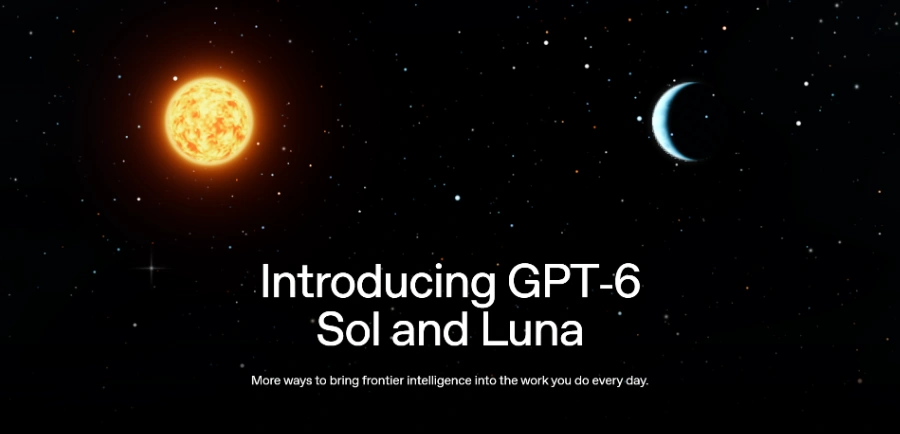


Updated on September 24, 2026
GPT-6 Sol is the mid-tier model in OpenAI's GPT-6 generation, built for coding, agents and complex work tasks. It arrived on September 22, 2026, alongside the smaller GPT-6 Luna, roughly 90 minutes after Claude Opus 5.5. API rates land at $2 per million input tokens and $10 for output, half of what the 5.6 generation charged. Free and Go accounts even get Luna in the desktop app.
OpenAI's GPT-6 family counts three models, the top-end Astra released on September 3, 2026, the mid-tier Sol and the lightweight Luna. The lab founded in 2015 trained Sol and Luna with methods similar to Astra's, carrying over its work on factuality, coding and computer use (GPT-5.6 had a Terra tier, this generation quietly dropped it).
According to OpenAI, Sol makes about half as many mistakes as GPT-5.6 Sol on internal factuality tests, and posts 33.2% on AutomationBench at xhigh effort for $0.27 per task, plus 68.8% on the DeepSWE v1.1 coding benchmark. In practice, the gpt-6-sol API model takes text and images across a 1,050,000-token context window.
| Model | Role in the family | Typical tasks |
|---|---|---|
| GPT-6 Astra | Top-end model | Deep analysis, research, science |
| GPT-6 Sol | Mid-tier for code and agents | Development, debugging, business automation |
| GPT-6 Luna | Light and fast | Summaries, extraction, quick answers |
GPT-6 Luna aims at high-volume tasks with a clear goal. Hand it 500 support tickets to sort and it gets through them for pennies. At high effort, it gains 5.4 points on AutomationBench over its predecessor at a 58% lower cost per task, again per OpenAI's own figures.
There is a nice twist for anyone on a free plan, since Luna ships to Free and Go accounts in the ChatGPT desktop app, while Sol stays with paid plans in Work and Codex, plus the API for everyone.
GPT-6 Sol costs $2 per million input tokens and $10 for output, against $4 and $20 for its predecessor, while Luna drops to $0.10 and $0.50. OpenAI describes these as permanent rates rather than a promotion, with cached input billed at 10% of the input price and Batch and Flex modes at half rate. Rates do drift over time, so treat OpenAI's pricing page as the final word.
Timing added some spice, as Anthropic shipped Claude Opus 5.5 about 90 minutes earlier at $4 and $20. Per Artificial Analysis, Sol is the cheapest route to a given intelligence score across most of the scale. In this race between large language models, cost per task has become the referee, and that is Sol's home turf.
GPT-6 Sol is the mid-tier model in OpenAI's GPT-6 generation, sitting below the top-end Astra and above the lightweight Luna. It targets coding, agents and complex work, priced at $2 per million input tokens and $10 for output. You can reach it through Codex, ChatGPT Work and the API under the id gpt-6-sol.
September 3, 2026 for GPT-6 Astra, then September 22, 2026 for GPT-6 Sol and GPT-6 Luna. No model is called plain GPT-6, since the generation splits into three tiers named after celestial bodies. Developers actually spotted the gpt-6-sol id in live API traffic six days before the official launch.
Sol reasons harder and aims at coding, agents and analysis, while Luna favors speed and bulk jobs such as summaries, extraction and classification. Twenty times cheaper on input, Luna is also the only one of the pair open to free accounts, through the desktop app. Sol lists a knowledge cutoff of April 20, 2026.
Budget and volume decide it. Sol costs half as much per million tokens and, per Artificial Analysis, stays the cheapest path up to an intelligence score of about 44, with Opus 5.5 peaking higher at its default setting. For agents running around the clock or bulk coding, Sol wins on the bill.
Verdict: Developers and teams running agents all day walk away with a lighter bill and Astra-grade reliability, and ChatGPT subscribers pick up higher usage limits; when a gnarly problem calls for the top score, Astra sits one menu away in the same account.