World Labs
#16 in AI Simulation
« A technology that transforms your images into 3D scenes that can be explored in your browser. Add camera effects, change the lighting and navigate worlds generated from famous photos or paintings »

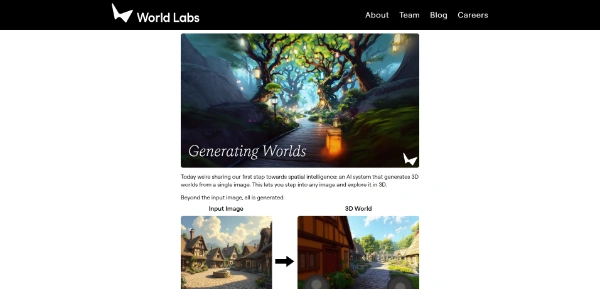


World Labs is a spatial intelligence company founded by Fei-Fei Li, and its product Marble generates explorable 3D worlds from text, images, video or 360 panoramas. Nvidia, AMD and Autodesk sit among its backers, with $1.23 billion raised overall. A free plan covers about four worlds a month, while paid tiers run from $20 to $95. Film previsualization, game prototyping and robot training are its three favorite playgrounds.
Marble builds a persistent 3D world in five to ten minutes from text, one or several images, a video clip or a 360 panorama. You describe an industrial loft with brick walls, and shortly after you are walking through it in first person. The scene outlives the visit, it stays stored, editable, expandable and downloadable, unlike on-the-fly worlds such as Google's Genie.
Chisel, the structural editor, goes further, you place plain boxes to lock the layout, then a prompt paints the style on top. Every world then exports as Gaussian splats, meshes or video toward Unity, Unreal, Blender or a VR headset. And where Meshy AI or Tripo AI output single objects, Marble delivers the whole set, still a rarity in AI-driven 3D simulation as a field.
World Labs announced the acquisition of robotics simulation startup SceniX in July 2026, then unveiled Atlas, its new multimodal world model, at the start of September 2026, in early access limited to select partners. The timeline moves fast.
The robotics turn is no whim. Companies like Lightwheel already train robots inside Marble-made environments, while filmmakers lean on it for shot previsualization (the Marble Labs hub documents both camps, case studies included).
The free plan grants 7,000 credits per month, roughly four worlds, with no card required.
Credit top-ups stay reserved for paying subscribers, from $5 for 5,000 credits to $50 for 63,000, and a standard Marble 1.1 generation costs 1,500 credits, enough to budget a project. Since these figures shift with each release, the grid published on marble.worldlabs.ai is the one that counts.
| Plan | Monthly price | What you get |
|---|---|---|
| Free | $0 | About 4 worlds, text and image inputs |
| Standard | $20 | 12 generations, splat and basic mesh export |
| Pro | $35 | 25 generations, high-res mesh, commercial rights |
| Max | $95 | 75 generations, every feature |
Marble is the first commercial product from World Labs, a multimodal world model launched in November 2025. It creates persistent, navigable 3D environments from text, images, video or a 360 panorama, then lets you edit, combine and export them toward game engines, the web or VR headsets.
Partly, yes. Marble includes a free plan with 7,000 monthly credits, about four worlds, no card required. Standard, Pro and Max add generations, deeper exports and commercial rights, and only paying subscribers can buy extra credit packs mid-month when a project runs hot.
Yes. Exports cover Gaussian splats, collider or high-resolution meshes and video, formats readable in Unity, Unreal Engine and Blender. On the web, the open source Spark library renders splats in Three.js, down to mobile and VR headsets. Export depth depends on your subscription tier.
It depends on the deliverable. Luma AI and Dream Machine output generated video clips, while Marble builds a persistent 3D scene where the camera moves freely after the fact. For a set you can reuse in a game engine, a previz or a robotics sim, World Labs holds the trump card.
Verdict: A single location photo can become a virtual film set in about ten minutes. Game studios, VFX teams and robotics labs will get the most from World Labs, and the free tier is plenty for a first walkthrough.