« An audacious start-up that could accelerate the execution speed of AI models by up to 10 times thanks to the development of its LPU (Language Processing Unit) »
Groq pushes open models past 500 tokens per second, and Nvidia licensed the recipe for $20 billion
Updated on August 8, 2026
Groq is a fast inference platform for open AI models, built on an in-house chip called the LPU and reachable through the GroqCloud API. Over 5 million developers run Llama, Qwen, GPT-OSS or Whisper on it, often beyond 500 tokens per second. The entry tier costs nothing and asks for no credit card; production traffic is billed per million tokens, with no subscription.
Pros
Some of the fastest inference throughput measured
Free tier with no credit card
OpenAI-compatible API, migration in minutes
Rock-bottom token prices, batch jobs half price
Cons
Open-weight catalog only, no GPT or Claude
No hosted fine-tuning for custom models
Tight rate limits on the free tier
A chip built for inference, not for rendering games
The LPU (Language Processing Unit) is an application-specific integrated circuit with a single job: serving language models with minimal latency and deterministic timing. Jonathan Ross, who worked on Google's first TPUs, founded the company in 2016 on a bet that GPUs, inherited from graphics rendering, would never be the right machine for inference.
Throughput ranges from 250 to over 1,000 tokens per second depending on the model, with energy efficiency the company rates at up to ten times that of GPUs. The bet paid off: in December 2025, Nvidia signed a non-exclusive license worth roughly $20 billion for the architecture, and Groq 3 LPX racks packing 256 chips are planned alongside its Vera Rubin platform.
Creating and testing a Groq API key step by step
GroqCloud, an all-open-weight catalog behind an OpenAI-compatible API
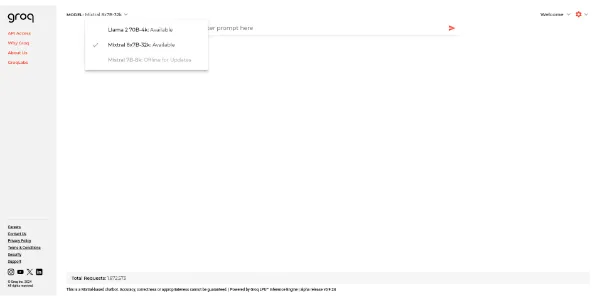
GroqCloud serves open-weight models only: Llama, Qwen, GPT-OSS, plus Whisper for transcription and synthetic voices. Nothing is trained in-house; Groq acts as an execution engine for other labs' work, and Meta handed it part of the inference behind the official Llama API in 2025.
Switching is a formality: the API mirrors OpenAI's, so you swap the base URL and the model name, and your app starts answering from LPUs (by the time the server restarts, the first reply is already back). Plenty of headroom to power coding assistants or a voice agent without touching the rest of your stack.
Voice agents, where every tenth of a second is audible
High-traffic chatbots and multi-call agent chains
Bulk audio transcription with Whisper
Try Groq for free, then pay per million tokens
An API key takes two minutes to create on console.groq.com, no card required, with rate limits set per model. Registering a payment method lifts those ceilings and moves billing to pure consumption. The Batch API halves every rate, prompt caching halves repeated input costs, and both discounts stack.
Models rotate in and out of the catalog at a steady pace, so check the pricing page on groq.com before budgeting anything; it is the only source that counts.
Yes, GroqCloud includes a free tier with no credit card: every model in the catalog is available, capped by per-minute and per-day rate limits. Adding a payment method then moves the account to pay-as-you-go billing per million tokens, with no subscription and no monthly minimum.
What is the difference between Groq and Grok?
Nothing connects the two companies: Groq, founded in 2016, designs chips and sells inference, while Grok is the chatbot from xAI, launched by Elon Musk in 2023. Groq holds the trademark and publicly asked xAI to pick another name when the confusion began.
Can I run GPT-5 or Claude on Groq?
No, the catalog sticks to open-weight models such as Llama, Qwen and GPT-OSS. Closed models stay with their publishers, which explains a common setup: Groq handles the speed-sensitive layer of the app, and a second provider covers the heaviest reasoning.
What does the Nvidia deal mean for GroqCloud customers?
Day to day, nothing changes: the December 2025 agreement is a non-exclusive license on the LPU architecture valued around $20 billion, and GroqCloud keeps operating independently under CEO Adam Winter, who took the role in 2026. Founder Jonathan Ross moved to Nvidia, while the platform, its API and its pricing stayed in place.
Verdict: Up to nineteen times cheaper than a comparable OpenAI tier, with replies that land before a loading spinner would: keep a closed model on the bench for the very hardest reasoning, and Groq becomes the natural home for developers shipping voice agents, live chatbots and heavy transcription pipelines.
To provide the best experiences, we use technologies such as cookies to store and/or access device information. Consenting to these technologies will allow us to process data such as browsing behavior or unique IDs on this site. Failure to consent or withdrawal of consent may adversely affect certain features and functions.
Functional
Always active
Storage or technical access is strictly necessary for the legitimate purpose of enabling the use of a specific service explicitly requested by the subscriber or Internet user, or for the sole purpose of transmitting a communication over an electronic communications network.
Preferences
Storage or technical access is necessary for the legitimate purpose of storing preferences that are not requested by the subscriber or person using the service.
Statistics
Storage or technical access used exclusively for statistical purposes.Storage or technical access which is used exclusively for anonymous statistical purposes. In the absence of a subpoena, voluntary compliance by your Internet service provider or additional third-party records, information stored or retrieved for this sole purpose generally cannot be used to identify you.
Marketing
Storage or technical access is necessary to create profiles of Internet users in order to send advertisements, or to track the Internet user on a website or on several websites with similar marketing purposes.
To provide the best experiences, we use technologies such as cookies to store and/or access device information. Consenting to these technologies will allow us to process data such as browsing behavior or unique IDs on this site. Failure to consent or withdrawal of consent may adversely affect certain features and functions.
Functional
Always active
Storage or technical access is strictly necessary for the legitimate purpose of enabling the use of a specific service explicitly requested by the subscriber or Internet user, or for the sole purpose of transmitting a communication over an electronic communications network.
Preferences
Storage or technical access is necessary for the legitimate purpose of storing preferences that are not requested by the subscriber or person using the service.
Statistics
Storage or technical access used exclusively for statistical purposes.Storage or technical access which is used exclusively for anonymous statistical purposes. In the absence of a subpoena, voluntary compliance by your Internet service provider or additional third-party records, information stored or retrieved for this sole purpose generally cannot be used to identify you.
Marketing
Storage or technical access is necessary to create profiles of Internet users in order to send advertisements, or to track the Internet user on a website or on several websites with similar marketing purposes.



 Claude Opus 5.5
  GPT-6 Astra
  Claude Fable 5.1