Ollama
#89 in LLM models
« Chat with local LLM language models like Llama2, Mixtral or Code Llama. Compatible with macOS, Linux and soon Windows »



Updated on August 5, 2026
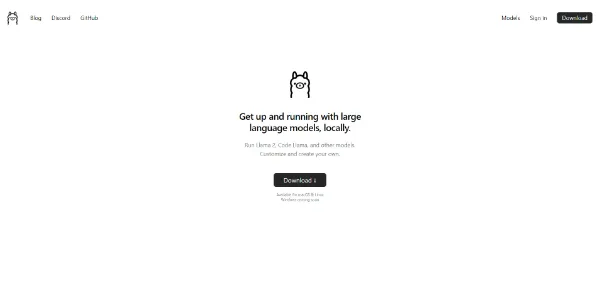
Ollama is an open-source tool that runs large language models directly on your computer, on Windows, macOS or Linux. One terminal command pulls Kimi, Mistral, DeepSeek-R1 or Qwen, and the model then answers with no internet connection at all. The software costs nothing and has passed 90,000 GitHub stars; an optional Ollama Cloud tier takes over when a model outgrows your hardware. Nothing you type ever leaves your disk, which is rather the whole point.
Ollama pairs a model manager with an inference server for large language models: ollama pull grabs a model, ollama run starts it, and an HTTP API in the OpenAI format listens on port 11434 of your machine. You type a question in the terminal and the answer scrolls by, even mid-flight (the first download, though, will test your patience on hotel wifi).
Modelfiles pin a behavior down, base model, parameters and instructions included, so it can be shared like a recipe. Tool calling and structured JSON outputs wire the whole thing into LangChain, LlamaIndex or an MCP server with no custom adapters.
The repository has passed 90,000 GitHub stars, territory few open-source AI projects ever reach; in the model library, DeepSeek-R1 alone counts over 88 million downloads.
4-bit quantization squeezes a 7-billion-parameter model into roughly 4 GB of VRAM, and an 8B runs comfortably with 8 GB of RAM on a laptop. A pleasant surprise along the way: Apple Silicon Macs do remarkably well with memory shared between CPU and GPU, while CUDA, ROCm and Vulkan cover PC graphics cards.
| Model size | Suggested hardware | Typical use |
|---|---|---|
| 7-8B quantized | 8 GB of RAM | writing help, light coding, learning |
| 13B quantized | around 8 GB of VRAM | sharper assistants, document analysis |
| 70B quantized | 40+ GB of VRAM | quality close to proprietary APIs |
Ollama Cloud runs oversized models on the publisher's datacenter GPUs with the same CLI and the same API: you change the base URL and nothing else. A free tier lets you sample it, Pro costs $20 per month with roughly 50 times the free quota, and Max climbs to $100 per month for sustained agent workloads.
Billing counts GPU time rather than tokens, with caps that reset every five hours and every week. Requests are never logged or used for training. Those figures held at writing time; the official pricing page is the place to double-check before you pay anything.
Yes, Ollama is completely free and open source under the MIT license, with no usage caps on your own hardware. Models from its library download at no cost too. Only Ollama Cloud, which hosts heavyweight models on datacenter GPUs, has paid tiers at $20 and $100 per month.
LM Studio is a desktop app built around a graphical interface, while Ollama favors the command line and an API other programs can call. If a terminal puts you off, LM Studio feels gentler; if you want a local model wired into scripts, coding assistants or agents, Ollama is the better fit. Both cost nothing.
Locally, yes: prompts and answers stay on your disk and never reach a third-party server, which helps with GDPR and NDA constraints. One caveat: the API has no authentication, so keep it bound to 127.0.0.1 rather than opening it to your network. On Cloud, Ollama states requests are never logged or trained on.
It does, on CPU alone, though generation slows down noticeably. A card with 6 to 8 GB of VRAM, such as an RTX 3060, handles 7B models comfortably, and Apple Silicon Macs perform surprisingly well. For 70-billion-parameter giants, plan on 24 GB of VRAM or the Cloud tiers.
Verdict: Nothing leaves your machine and nothing is metered per token: that is Ollama's appeal for developers, privacy-bound teams and anyone building on open models, with Ollama Cloud on standby for the day your local GPU falls short.

« An all-in-one creative platform that brings together more than 30 image and video models in a single interface. It includes camera controls that let you direct like a real filmmaker, characters that remain consistent from scene to scene, and ready-to-use tools for ads and short-form content »